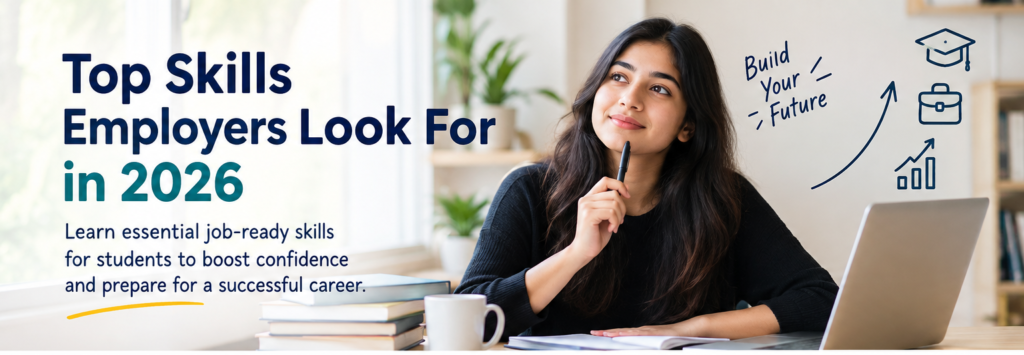
Top Skills Employers Look For
You graduated with a degree. You also earned impressive grades. However, these alone rarely guarantee employment. Today, Top Skills Employers Look For include clear thinking, speaking, and communication. How can you cultivate them before becoming an employee?
Let us find out how. Nothing too complicated. Just plain talk.
Why the Top Skills Employers Look For Matter More Than Ever
The job market changes rapidly. New technologies keep emerging each year. Firms today look at what you can do, not what you studied. This explains why Top Skills Employers Look For in 2026 go beyond technical ability. Some of them are basic human skills, such as rational thought, clear communication, and collaboration. Additionally, these skills can be learned. An expensive course isn’t required. You simply need practice.
According to a survey conducted by NACE and presented at Newman University, there is an interesting disconnect. Employers rate these skills as crucial. However, they believe that many graduates are lacking in these areas. This is your opportunity to make yourself stand out.
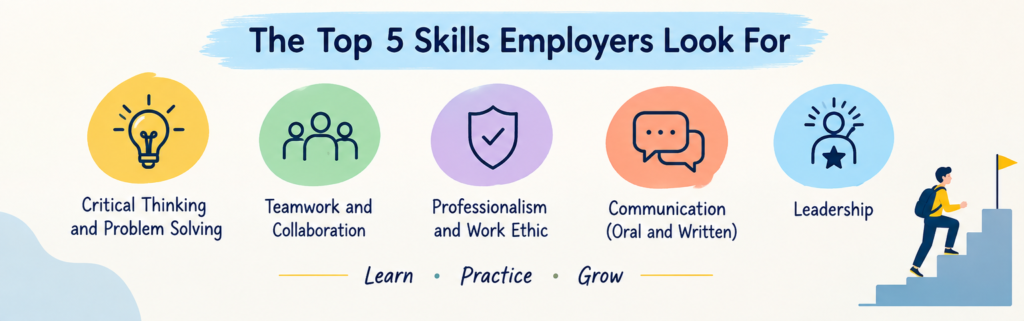
The Top 5 Skills Employers Look For
Every recruiter is different. But these five skills show up again and again. They are the top skills employers look for across almost every industry.
1. Critical Thinking and Problem Solving
This is where it all lies. Companies want employees who are able to think independently.
This is one of the most valued traits among employers in any profession, whether it is marketing, engineering, etc.
Critical thinking is when a person is able to:
- Consider facts before making a decision
- Question anything that doesn’t make sense
- Make comparisons between two or three possibilities
- Learn from one’s mistakes
It is a skill that becomes a habit. You cannot turn it on and off as you wish.
How to build it:
- Participate in class discussion and pose “why” questions
- Engage in internships or practical experience
- Tackle case study questions or puzzles
- Strive to solve minor problems around you
This ability is greatly valued by employers. However, many graduates lack proper preparation for it. Therefore, the more practice you get, the more brilliant you become.
2. Teamwork and Collaboration
Not many occupations consist solely of one individual’s efforts. Even for freelancers, there is always interaction with customers. Group assignments can be a bother, but they help a great deal in learning how to divide tasks, listen to others, and accept diverse perspectives. Why do employers like employees who can work in a team? Teams accomplish more than individuals, enhance creativity, improve efficiency, and create an atmosphere of goodwill.
How to build it:
- Take part in group assignments
- Join college clubs or societies
- Volunteer for events
- Help a classmate who is stuck
Small tip: give credit to others. It builds trust quickly.
3. Professionalism and Work Ethic
Sounds like this one is a simple one. But it holds great importance. All employers seek employees who are dependable. Those who come to work on time and complete their tasks. Those who take responsibility. Professionalism is rated among the highest valued skills by most employers but still not all new hires demonstrate professionalism. According to the survey conducted at Newman University, employers consider it an essential skill, but only a few new hires exhibit it.
Professionalism looks like this:
- Being on time for classes and meetings
- Meeting deadlines
- Replying to emails politely
- Owning up to your mistakes
- Staying calm under pressure
How to build it:
- Treat every assignment like a real job task
- Set small daily goals
- Avoid last-minute work
- Dress and speak well in interviews and calls
Good habits in college become good habits at work.
4. Oral and Written Communication
A good idea is not much use if you can’t express it. Companies need people who can communicate well. They need people who can write emails and messages clearly. We now send a lot of texts every day. This can be bad for our writing. Excessive screen time can also affect verbal communication. So, strike a balance.
To improve speaking:
- Keep your message short and simple
- Talk with people, not at them
- Listen more than you speak
- Practice in front of a mirror or friend
To improve writing:
- Plan your points before you write
- Use short sentences
- Proofread every time
- Read your work out loud
Strong communication also helps you become a better leader. Which brings us to the last skill.
5. Leadership
Leadership does not necessarily require having a large title. It all boils down to initiative. This involves directing others, decision-making, and motivating individuals. It also involves remaining optimistic even when times are hard. More employers no longer give leadership top priority. However, it is very important. It develops as a result of the first four skills.
How to build it:
- Lead a college project or event
- Mentor a junior student
- Take charge when a group feels lost
- Learn what your own strengths are
When people see your energy, they follow it. That is real leadership.
Job-Ready Skills for Students: Start Now
There are many who leave thoughts about their career until their final year. Do not make this mistake. The development of job-ready skills in students requires time. The most sought-after skills by employers develop over time. So start right away. Small things can make a difference.
Here is a simple plan:
- Year 1: Join a club. Improve your communication.
- Year 2: Work on group projects. Try online courses.
- Year 3: Do an internship. Build a small portfolio.
- Final year: Practice interviews. Polish your resume and LinkedIn profile.
Also, do not ignore digital skills. Basic Excel, presentation tools, and AI tools are useful in most jobs today. Add them on top of the core five.
Skills Needed to Get a Job: A Quick Checklist
Use this list to check where you stand. It covers the top skills employers look for. Be honest with yourself.
- Can I explain my ideas clearly?
- Can I work well with people I do not know?
- Do I finish tasks on time?
- Can I solve a problem without being told how?
- Have I led something, even a small task?
- Am I ready to learn new tools?
If you said “no” to any of these, that is fine. Pick one and work on it this month. The skills needed to get a job are not a secret. They are learnable. Progress comes from small daily effort.
How to Show These Skills to Employers
Having skills is step one. Showing them is step two.
On your resume:
- Use real examples, not just words like “hardworking”
- Add numbers where you can (for example, “led a team of 5”)
- Mention projects, internships, and club roles
In your interview:
- Tell short stories about real situations
- Explain the problem, what you did, and the result
- Stay calm and speak slowly
- Ask smart questions at the end
Remember, the top skills employers look for in candidates are best proven with examples. A short, honest story beats a long claim.
Final Thoughts
While a degree may assist you in being seen, practical skills will assist you in succeeding in your job. Critical thinking, teamwork, professionalism, communication, and leadership are important for establishing a good career path. It is always best to start learning these skills early on through practice and internships.