
Meta Description: Confused about career options after B.A.LL.B? Here are 12 real paths, salary ranges, and honest tips to help you pick the right one.
Well, you are finally completing your B.A.LL.B. Five years of study. Many moot court cases. Way too many laws. What should you do next? Now that is what you want to know.
Here is the good part; you are not limited in options. You only need some guidance. We’ll walk through real career options after B.A.LL.B. Not the vague “you can become a lawyer” advice. Actual paths, with actual numbers. Let’s get into it.
Why B.A.LL.B Graduates Have an Edge
B.A.LL.B. is not a legal degree alone. It’s Law and Arts. You have learned Political Science, Sociology, Economics, and History in addition to Contracts and Constitutional Laws. This aspect counts. You have an understanding of the reasons behind the laws rather than the laws themselves, and employers value this.
So before we list the career options after B.A.LL.B, remember this. Your degree already stands out. Use that.
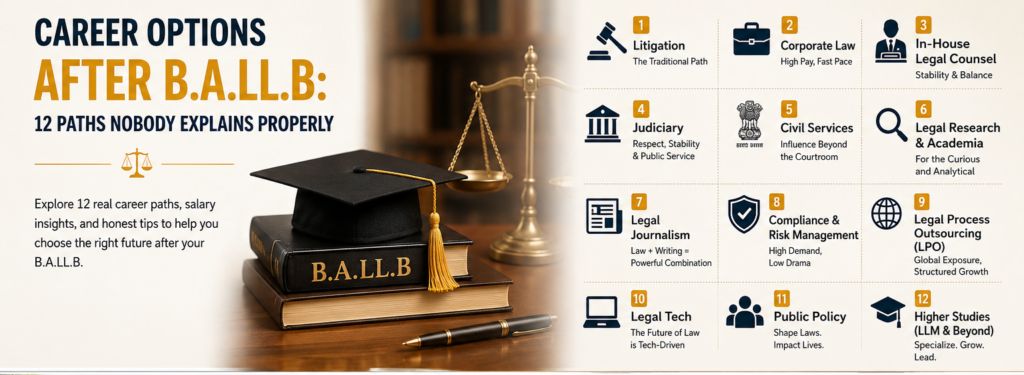
1. Litigation (The Traditional Path)
This is the classic choice. You enrol with your State Bar Council. You start practising under a senior advocate.
- Years at the beginning are difficult. The pay is poor.
- Once the first 4-5 years have gone by, everything starts looking up.
- Litigation specialists (taxes, patents, crime) make fantastic money.
If you enjoy arguing, thinking on your feet, and courtroom drama, this fits.
2. Corporate Law
Corporate law is one of the most popular career options after B.A.LL.B right now. Big law firms hire fresh graduates every year through campus placements.
You’ll work on:
- Mergers and acquisitions
- Contract drafting
- Regulatory compliance
- Due diligence
Starting salaries here are among the highest for fresh graduates. Long hours, though. Be ready for that trade-off.
3. In-House Legal Counsel
No longer a law firm but a company. Think about Flipkart, Infosys, or even a banking company. You would have to deal with legal matters of that particular company. Contracts, employment disputes, vendor disputes. Better work-life balance as compared to litigation and big law firms. Income is more predictable.
4. Judiciary (Judicial Services)
Want to become a judge? This is your route.
You clear the state Judicial Services Examination after your B.A.LL.B. No extra degree needed for most states.
- It’s a respected, secure government job.
- Competition is intense. Lakhs apply every year.
- Preparation usually takes 1-2 years of focused study.
If stability and public service appeal to you, this is worth serious thought.
5. Civil Services (UPSC, State PCS)
Here is where your qualification B.A.LL.B, will help you immensely. Political science, Governance, and Constitutional Law all have direct connections to the UPSC Syllabus.
In fact, most students who get B.A.LL.B pursue civil services just because of this reason only. One of the better career options after B.A.LL.B is definitely Civil Services.
6. Legal Research and Academia
Not everyone wants a courtroom. Some prefer libraries and ideas.
- Join a law firm’s research team.
- Work with think tanks on policy papers.
- Pursue an LLM and teach at a law school later.
This path suits people who enjoy writing, analysis, and depth over speed.
7. Legal Journalism
This one surprises people. But it’s growing fast.
Legal journalism needs people who actually understand law. Not just writers who Google terms.
- Cover court judgments for legal news portals.
- Explain policy changes for mainstream media.
- Write legal explainers for websites (yes, like this one).
If you like writing and law equally, this niche is wide open right now.
8. Compliance and Risk Management
Every organization needs someone to keep an eye on regulations. The new GST regulations. Privacy of data regulations. Workforce regulations. These professionals ensure that no law is violated by the organization inadvertently. Not as glamorous as litigation. But lucrative and popular. It is a very good career choice among other choices after B.A.LL.B., especially in banking, fintech, and pharma sectors.
9. Legal Process Outsourcing (LPO)
Foreign law firms outsource document review and legal research to Indian LPOs.
- Good starting pay.
- Structured hours.
- Great exposure to international legal work.
It’s a solid stepping stone, especially if you want global law firm experience later.
10. Legal Tech
Here’s the fresh angle most guides skip.
The market for legal tech is thriving, with start-ups creating AI systems to automate contract analysis, case prediction, and compliance management.
These start-ups require individuals who are familiar with both legal issues and the development of products. Programmers not required – they need someone who understands the law.
- Roles: legal product analyst, contract-tech specialist, legal AI trainer.
- Pay varies, but growth potential is high.
- Very few law graduates are exploring this yet. That’s your opening.
Among all the emerging B.A.LL.B job opportunities, this is the one to watch over the next five years.
11. Public Policy
The government-funded think tanks, non-government organizations, and policy consultation firms employ law graduates on a regular basis.
Your work will involve drafting policy papers, analyzing bills, and studying the impact of the regulation. It is similar to civil services but not as tough as the competition for the same.
12. Higher Studies (LLM and Beyond)
Not ready to jump into a job? An LLM can sharpen your specialisation.
- LLM in Corporate Law, IP Law, or Criminal Law from a strong college opens doors.
- Studying abroad (UK, US, Australia) boosts international law firm chances.
- It also strengthens academia and judiciary prospects.
Just don’t do an LLM only because you’re unsure. Do it with a clear goal.

Quick Comparison: Which Path Fits You?
- Love arguing and courtroom energy? → Litigation
- Want high pay early on? → Corporate law
- Prefer stability? → Judiciary or civil services
- Enjoy writing and explaining? → Legal journalism or legal tech
- Want steady hours? → In-house counsel or compliance
- Curious about the future of law? → Legal tech
How to Choose the Right One
Don’t pick based on what your classmates are doing. Ask yourself these questions instead.
- Do you enjoy fast-paced pressure, or calm, deep work?
- Do you want financial stability now, or are you okay building slowly?
- Are you drawn to people (litigation, journalism) or systems (compliance, legal tech)?
Your answers will point you toward the right career options after B.A.LL.B faster than any ranking list will.
Conclusion
There’s no single best career after B.A.LL.B. There are several Career Options After B.A.LL.B, and the best one is the one that suits you. Litigation is about patience. Corporate law is about speed. Legal technology is about curiosity. Judiciary is about discipline. Select the career path based on the way you want to work, not based on the highest possible salary. The right selection among the career options after BA LLB will be much more valuable than even the highest possible salary.