
AI Is Changing the Future of Education in ways students can’t ignore. Discover how artificial intelligence in education is reshaping learning today.
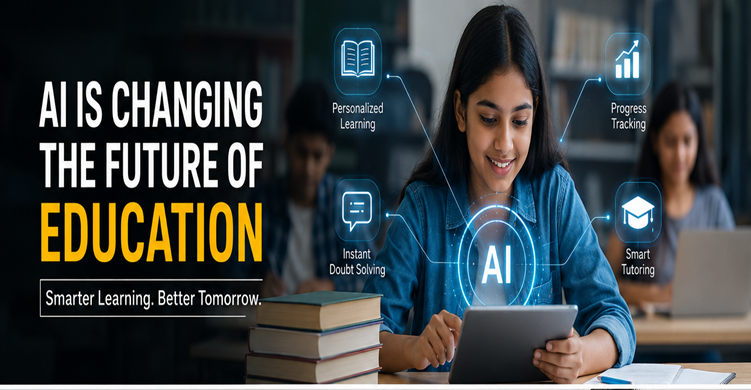
Do you remember that “doing your homework” was all about sitting alone with your textbook and perhaps a cup of chai as companionship? Those days now seem far away. Today, students use chatbots, create practice questions in seconds, and get instant feedback on their essay tasks that once took teachers much longer. This is not some fantasy of the future anymore. AI Is Changing the Future of Education in real-time, here and now, in a way that is both exhilarating and unnerving.
As a student and a teacher, let’s figure out together what exactly is going on.
Why Everyone Is Talking About AI in Classrooms
In the past, artificial intelligence for education existed in very basic forms, such as software programs that would correct your grammar. In today’s world, however, artificial intelligence is embedded in just about everything associated with the learning process. Let’s see why this has happened:
- Learning tailored to each student on a massive scale: AI can identify where a student is struggling and adjust the difficulty of questions accordingly. A single teacher may not be able to do this for 40 students at the same time.
- 24/7 doubt solving: You don’t have to wait until the next class to get an answer. AI tutors are available anytime and can explain the same question in different ways without getting tired.
- Efficient content creation for teachers: With AI, educators spend less time creating presentations and quizzes and have more time to devote to mentoring.
- Insights from data: Schools and colleges use AI-powered dashboards to know exactly which students are falling behind in their studies.
AI Is Changing How Students Learn
However, here is a fact that is usually not mentioned: while one person is studying better thanks to artificial intelligence, another is just studying less because of it. AI is changing how students learn, but some students are also using it to avoid learning. The difference between these two groups is smaller than many people realize.
For example, imagine a student struggling to understand a difficult economics concept. With AI’s help, the student can break it down, understand it better, and solve the problem on their own. Then imagine a student who takes an answer provided by the AI directly in their assignment without even looking at it. They are both using AI for educational purposes, but one of them is actually doing the job while the other is outsourcing their brain.
Now this is the actual dilemma that every student should solve.
How Is AI Affecting Students’ Learning in Practical Terms?
Understanding how AI Is Changing the Future of Education means looking beyond chatbots and homework help. AI is influencing how students study, practice, prepare for exams, and even plan their careers.
Positive impacts:
- Immediate doubt clearance allows the student to spend more time practicing.
- Students can now work on their weaknesses through adaptive practice tests rather than spending time studying what they already know.
- Linguistic tools are assisting students from regional medium backgrounds in accessing English study materials.
- Career guidance tools help Indian students discover career options beyond traditional fields like engineering and commerce. They suggest careers based on students’ skills and abilities.
The not-so-good effects:
- There is a tendency of over-reliance, and some students have ceased trying to solve a problem even before turning to an AI program to find the answer.
- AI can affect critical thinking when students trust its answers without checking the facts. This can be especially risky in subjects like history and law, where details and different viewpoints matter.
- The ability to write effectively has been undermined for those students who allow AI to create an essay on their behalf.
- Plagiarism and AI-detection tools have become more advanced. Colleges may take action against students who submit AI-generated assignments without adding their own ideas.
The takeaway? AI is neither a miracle nor a menace. It’s a tool, and like any tool, its impact depends entirely on how it’s used.
Tips for Students: Using AI the Smart Way
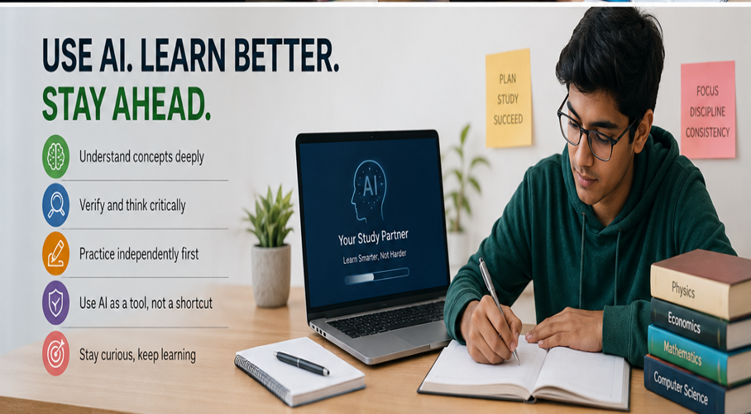
As AI Is Changing the Future of Education, students need to learn an important skill: knowing when to use AI and when to think independently. If you want AI to actually help your learning instead of quietly sabotaging it, keep these habits in mind:
- Use AI to explain concepts, not to write your final answers for you.
- Always attempt a question yourself first, then use AI to check or improve your approach.
- Cross-check important facts, especially for subjects involving dates, laws, or statistics.
- Treat AI-generated content as a first draft, not a final submission, especially for assignments.
- Set boundaries, decide in advance which tasks you’ll do independently and which ones AI can assist with.
What Teachers and Institutions Are Doing About It
Neither colleges nor schools are remaining inactive in this regard. Many educational institutions are changing their assignments to focus more on discussions and practical tasks. This is because AI can easily provide answers to simple factual questions. Orals, written assignments in class, and project assignments have made a comeback, not because of the failure of the technology but because of adaptation to it.
Teachers are no longer just providers of information. Their role is changing to guiding and supporting students because AI can provide quick answers to many questions.
The Road Ahead
The reality is, you can’t put this genie back in the bottle. As mentioned in AI Is Changing the Future of Education, fighting against it all together is akin to not using calculators for fear of mental math. The best approach is to use technology responsibly, stay curious, and never give up learning just because AI makes things easier. Students who can balance AI’s speed with their own thinking will have an advantage in exams and their future careers.
Conclusion
AI Is Changing the Future of Education, but it isn’t here to replace learning; it’s here to reshape it. Whether it becomes your best study partner or your biggest shortcut depends entirely on how you choose to use it. The students who thrive in this new era won’t be the ones who avoid AI, but the ones who master it without letting it master them.