
Introduction
So you have chosen IELTS for yourself. Great choice.
However, you are facing four skills, an assessment system which is not quite clear for you, and hundreds of YouTube tutorials providing hundreds of tips for you. Relax. This is just fine.
Any beginner has felt like this on his/her very first day. There is no special trick to do with it. The key is sticking to a program designed for beginners. That’s exactly what these IELTS preparation tips for beginners are built for – no jargon, no fluff, just a clear route from “I don’t know where to start” to Band 7+.
Let’s get into it.
First, Let Go of the “I Need Perfect English” Myth
Here’s something most guides won’t tell you upfront.
You do not need flawless grammar or a huge vocabulary to hit Band 7.
You need:
- Clear communication
- Relevant answers
- Reasonable accuracy
- Enough range to express your ideas
That’s it. Perfection is not the goal. Clarity is.
This single mindset shift is one of the most underrated IELTS preparation tips for beginners, because it removes the fear that stops people from even starting.
Know the Exam Before You Touch a Single Practice Test
You can’t prepare for something you don’t understand.
IELTS has four parts:
- Listening– 40 questions, 4 recordings
- Reading– 40 questions, dense passages
- Writing– Two tasks, 60 minutes total
- Speaking– A short interview, roughly 11-14 minutes
Each section is scored on a 0-9 band scale. Your overall band is an average of all four. It is more important than people think. In the case that you have a good Speaking ability while your Writing skill is poor, spending hours working on Speaking will not help you improve your overall score significantly. Students often prepare “equally” in all four areas.
Start With a Reality Check, Not a Study Plan
Before you open a single vocabulary list, take one full-length practice test.
Yes, even if it feels terrible. Yes, even if you score low.
This single step tells you:
• What skill is bringing down your grade?
• Is your problem with vocabulary, timing, or understanding?
• How close (or how far) are you from your goal band?
Beginners usually ignore this process and just start practicing randomly. This is like going on a road trip without even knowing where you are.
Of all the IELTS preparation tips for beginners floating around online, this is the one people ignore most often – and regret later.
Build a Study Routine You Can Actually Stick To
Forget the idea that you need 6 hours a day. You don’t.
A realistic, sustainable routine looks more like:
- 20 minutes of Listening practice
- 30 minutes of Reading with timed passages
- 30 minutes of Writing practice, 3-4 days a week
- 15-20 minutes of Speaking practice, ideally out loud
Consistency beats intensity every single time. A beginner who studies an hour daily for two months will almost always outperform someone who cram-studies for a week straight.
This is one of the more practical IELTS preparation tips for beginners because it respects real life-college, work, family, everything else you’re juggling.
Fix Your Vocabulary the Smart Way
Random word lists don’t work. You forget them in days.
Instead, learn vocabulary in topic clusters, since IELTS repeats certain themes constantly:
- Education
- Environment
- Technology
- Health
- Work and career
- Society and culture
When you learn words tied to a topic, you can actually use them in Speaking and Writing, not just recognize them in Reading.
Tackle the Skill Everyone Underestimates: Speaking
Indian test-takers often get comfortable with grammar rules but freeze the moment they need to speak spontaneously.
Sound familiar?
Here’s a fix that works well for beginners:
- Record yourself answering Part 1 questions
- Play it back and note hesitations, fillers, and repeated words
- Answer the same question again, this time smoother
Do this daily for two weeks and you’ll notice a real shift in fluency. It’s uncomfortable at first. It works anyway.
Writing Task 2 Deserves Extra Attention
Task 2 carries more weight than Task 1, yet beginners often spend equal time on both.
A simple structure that works for most essay types:
- Introduction – Restate the question in your own words, state your position
- Body Paragraph 1 – One clear idea, explained, with an example
- Body Paragraph 2 – A second idea, explained, with an example
- Conclusion – Summarize briefly
Don’t memorize essays. Examiners can tell, and it usually backfires on Task Response scoring.
Watch Out for These Specific Slip-Ups
A few patterns show up again and again among Indian beginners:
- Overusing formal, textbook-style phrases that sound unnatural in Speaking
- Mixing up prepositions (a common carryover from regional language structures)
- Writing overly long, complex sentences instead of clear, direct ones
- Relying on memorized answers instead of genuine, spontaneous responses
Catching these early saves you months of repeating the same mistakes.
Take Mock Tests, But Review Them Properly
A mock test without review is just a number. It tells you nothing useful on its own.
After every mock:
- Identify what went wrong
- Identify why it went wrong
- Note it down somewhere you’ll actually revisit
Two well-analyses mock tests are worth more than five rushed ones. Most solid IELTS preparation tips for beginners come back to this same idea: review beats repetition.
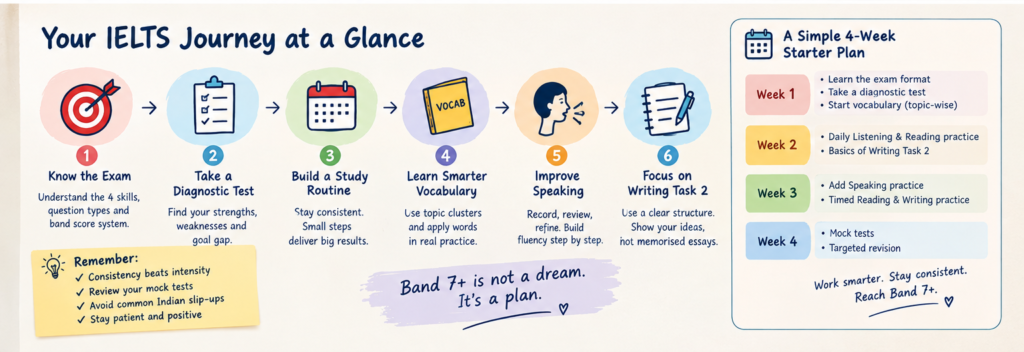
A Simple 4-Week Starter Plan for Beginners
If you want a rough shape to follow, here’s one:
- Week 1 – Get to know the examination format, take a diagnostics test, and start vocabulary for topics
- Week 2 – Daily Listening & Reading practices, start with the basics of Writing Task 2
- Week 3 – Introduce Speaking practice, add timed Reading & Writing practices
- Week 4 – Mock tests and targeted revision
Adjust the pace based on your diagnostic results. This is a starting frame, not a rule book carved in stone.
Final Thoughts
Band 7+ is not about working harder than everybody else. It is about working smarter, being consistent, and addressing the correct weaknesses at the appropriate times. Get a diagnostic test done first. Create a schedule that you can stick to. Concentrate more on your weaker area. Analyze your mistakes rather than just scoring. Follow these IELTS preparation tips for beginners with patience, and Band 7+ stops looking like a stretch goal — it starts looking like a realistic outcome you’re steadily working toward.