
Skills vs. degree in 2026: learn what employers expect, how to build job-ready skills, and why clever students need both. Read before you choose a path.
Introduction
Your cousin has an MBA but no job offer. Your neighbour’s son quit college and now earns well. Sounds familiar, right? Every Indian family has heard stories like these. They make the skills vs. degree debate feel very personal. This is the bitter truth. Both accounts are genuine, but both lack the whole story. Over my career in journalism, I have seen this issue evolve many times. In 2026, it has become quite real. Now hiring officers only ask you one question first. “What can you do for us?” The second question will be your college name.
So does it mean you need not go to college? Not at all. And are grades enough? Again, not quite. The right approach lies somewhere in between. So let us get to it. In simple terms. In clear steps. With no fear.
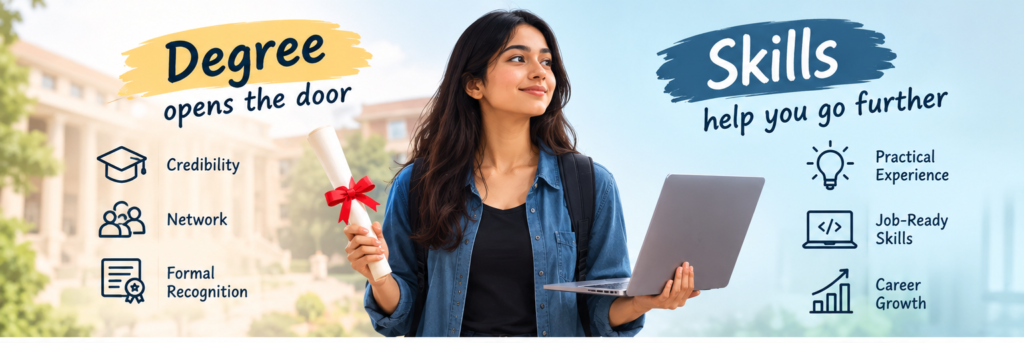
Why the Skills vs. Degree Debate Is Louder Than Ever
Organizations work with less personnel. Equipment updates are made every few months. AI has been introduced into almost all professions. Managers cannot afford to spend six months waiting for the novice to add value. They need evidence of competence. Degrees provide some evidence. Skills provide quicker evidence. This is the true relevance of skills in 2026. This is not about degrees being rendered irrelevant. It is about time. Organizations need people who will make contributions quickly.
Here is what has shifted:
- Hiring is moving from “which college?” to “which projects?”
- Interviews now include live tasks and case problems.
- Teams expect less hand-holding from freshers.
- Recruiters check your online profile before your resume.
Parents feel this change too. They worry. That worry is fair. But it helps to see where each side truly stands in the skills vs. degree question.
Where a Degree Still Wins
Let me be fair to degrees. They are not dead. Not even close.
Some doors simply stay shut without one:
- Medicine, law, teaching and chartered accounting
- Government jobs, bank exams and UPSC
- Admissions and visas for study abroad
- Many large companies that filter resumes by graduation
Such cases don’t even arise. You have to get the degree. The skills come into play only then. The degree also has some other thing. Some silent but potent things. Friends. Seniors. Alumnus. Professors who know you. Many career journeys begin with such introductions. The degree also makes you think. Skills can be learned within weeks. But thinking is an art to be learned over years. Remember that point. It will matter later.
One more point. The skills vs. degree debate online often ignores this part. Many students in smaller towns rely on a degree for credibility. A known college name can calm a worried family. It can also help with education loans and campus hiring. Those are real benefits.
My 3-Proof Test for Employability
Here is a simple idea I share when students ask me for advice. Employers want proof that you can deliver. That proof comes in three forms.
1. Paper proof. Your degree, marks, and certificates.
2. Practice proof. Projects, internships, freelance work, a portfolio, a blog, a GitHub page.
3. People proof. A mentor’s recommendation, a manager’s reference, a good LinkedIn network.
Now check yourself. How many do you have today?
Most students have only paper proof. That is the real gap in the skills vs. degree discussion. One strong paper proof plus one strong practice proof beats three weak ones. Aim for at least two. Try for all three.
Degree vs Skills for Jobs: A Reality Check
The answer changes by field. So do not follow blanket advice from the internet.
- Medicine, law, teaching: Degree is compulsory.
- Government jobs: Degree is the entry ticket. Skills help in mains and interviews.
- IT and software: Skills lead. Degree helps in the first screening.
- Marketing, content, design: Your portfolio speaks louder than your marks.
- Finance and consulting: Both matter. College brand also counts.
Notice something? Nobody says “only skills” or “only degree”. The winning mix just differs. That is why the right answer is never the same for two people.
Skills vs. Degree: When Skills Take the Lead
Some industries just don’t give a damn about your college. Digital marketing, video editing, mobile application development, data analysis, and content writing are some of the industries. This is where a hiring manager usually starts by asking for a sample of your work. Your degree here only makes you look good. It’s here that the skills-over-degrees mantra is fully realized.
But even here, a degree helps in the long run. It gives you depth. Skills give you speed. Together, they make you hard to replace. It is also easy to start small here. A laptop and a free tool are enough. That is where the skills vs. degree balance really tips.
Skills Employers Look For in Freshers
Forget fancy buzzwords. Most recruiters want a few basic things done well:
- Clear communication: Write a short email. Speak without rambling.
- Data sense: Read a sheet. Spot a trend. Ask a smart question.
- AI comfort: Use AI tools well. But check their answers.
- Problem solving: Break a messy task into small steps.
- Ownership: Finish what you start.
- Learning speed: Pick up new tools without being told twice.
Notice that none of these come from one subject. They come from practice. Your degree is the place. Practice is the habit. That is why the skills vs. degree argument often misses the point.
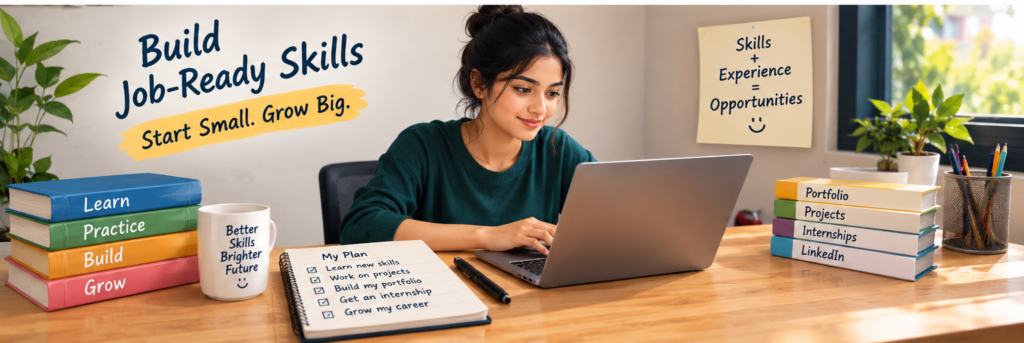
Build Job-Ready Skills for Students in 90 Days
You do not need a big budget. You need a plan. Try this.
Days 1 to 30: Pick and explore.
- Read 20 job posts for the role you want.
- Note the skills that repeat.
- Choose two to learn first.
Days 31 to 60: Build.
- Make one small project for each skill.
- Share it publicly. A simple page is enough.
- Ask one senior for feedback.
Days 61 to 90: Show.
- Add projects to your resume and LinkedIn.
- Apply for one internship or freelance task.
- Write what you learned in a short post.
- Keep a weekly log of what you finished.
Do this beside your classes. Not instead of them.
Skills vs. Degree Mistakes Students Make
I see the same errors every year.
- Collecting certificates without building anything
- Copying tutorials and calling it a project
- Ignoring semester marks completely
- Waiting for final year to start
- Learning skills that no job post asks for
- Hiding your work because it feels “not good enough”
Fix these six, and you are already ahead of most batchmates. Most of them are free to fix. They only need a little courage and a calendar. Also, do not compare your first project with a professional’s tenth. Everyone starts messy. Progress is what employers notice. Ship early. Improve often. Repeat.
Conclusion
Skills vs. degree is not a fight. It is a team effort. While your degree will show that you have a solid base, your skills will be the evidence of what you can accomplish. By 2026, developing tangible skills and gaining experience and evidence can set you apart. Your degree will allow you entry; your skills will allow you to progress.