Should you learn AI before college? Discover why, how to start, free courses, and a simple 30-day plan with AI skills for students.
Introduction
Your phone already uses AI. So does your music app. So does your search bar. Yet most students never learn how it works. Here is a question many teens and parents ask. Should you learn AI before college?
The answer is yes, but not the way you think. You don’t need to code like an engineer. You need to know AI, use it well and ask questions. This guide helps you do this. Simple and beginner friendly. It is very easy.
Why You Should Learn AI Before College
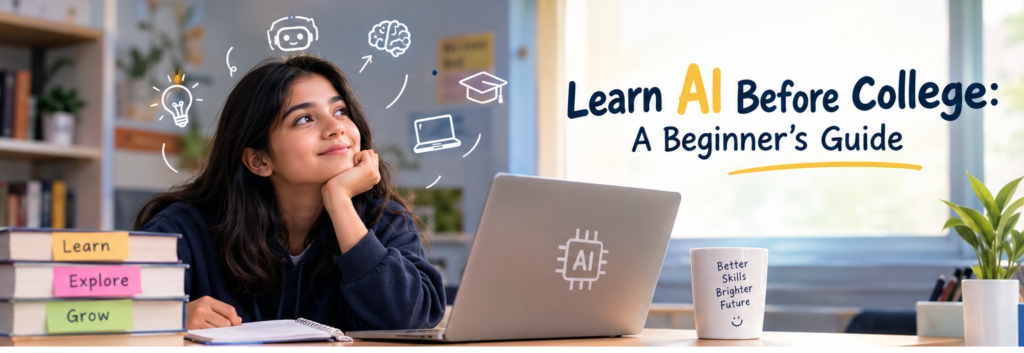
College life is rapidly changing. Instructors incorporate AI in classroom discussions. Interviewers pose questions concerning AI skills in job interviews. Even in the Arts and Commerce classes, AI technologies are being applied in research and design.
Getting to know AI from an early stage will mean walking into college with prior knowledge. You will not be stressed when the instructor mentions prompts, models, or datasets. It is similar to typing, nobody bothers to inquire whether typing is important or not, AI is headed that way too. Students who learn AI before college also feel calmer in class. They spend less time catching up and more time learning.
Artificial Intelligence for Beginners: The Simple Version
Keep things simple. The beginner’s guide to artificial intelligence begins with one concept. Artificial intelligence is the computer software that identifies patterns in data and then applies these patterns to make a prediction or generate an output.
Here is an example. Give a child lots of pictures of cats. In no time, the child will be able to recognize a cat from any picture. Artificial intelligence works the same way, but on a much larger scale.
Three terms to know:
- Machine learning: computers learn from examples.
- Generative AI: tools that create text, images, or code.
- Prompt: the instruction you give an AI tool.
That is enough to start. You can add more later.
Benefits of Learning AI Before College
Let’s talk about why it pays off to learn AI before college. Here are the biggest wins:
- Better grades: AI can explain tough topics in simple words.
- Faster research: sort and summarize sources in minutes.
- Smarter career choices: see which jobs AI will change, and plan ahead.
- Stronger applications: a small AI project shows initiative.
- Less fear: tools feel normal after months of use.
This is one thing that few guides mention. The best part is being able to judge. AI can seem very sure and still get things wrong. When students practice this early, they learn to verify, compare, and question. It is why you should learn AI before college, not after.
AI Skills for Students: What Actually Matters
Forget fancy coding for now. These AI skills for students matter most at the start:
- Prompting: ask clear, specific questions.
- Fact-checking: verify every claim an AI makes.
- Data sense: read charts and question numbers.
- Ethics: know what is fair, safe, and honest.
- Basic Python (optional): useful if you aim for tech or science.
Notice something? Four of five skills need no code. That is good news for commerce, arts, and humanities students.
AI Practice Ideas by Stream
Not sure what to try? Pick one that fits your path:
- Science: ask AI to explain a lab result in plain words.
- Commerce: have AI draft a mock business plan, then fix its gaps.
- Humanities: compare an AI summary of a poem with your own reading.
- Design or media: test AI image tools and note what feels fake.
How to Learn AI Before College: A 30-Day Plan
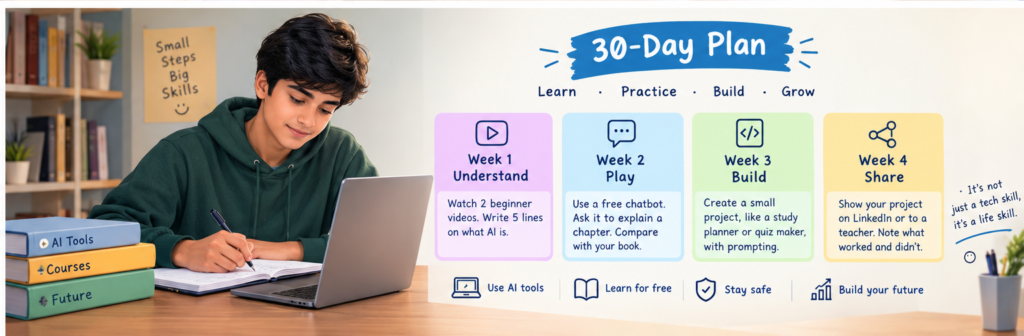
Here is the part most blogs skip: a real schedule. This is how to learn AI as a student without burning out. Spend 30 minutes a day. That’s it.
- Week 1, Understand: Watch 2 beginner videos. Write five lines on what AI is, in your own words.
- Week 2, Play: use a free chat bot. Ask it to explain a chapter of a textbook. Then compare its answer to the book.
- Week 3, Build: build a small project, like a study planner or quiz maker, with prompting.
- Week 4, Share: share your project on LinkedIn or show it to a teacher. Write down what worked and what didn’t.
Keep a simple AI diary. Note the prompt, the answer, and the mistake. That diary is gold. It proves you chose to learn AI before college and stuck with it.
Best AI Courses for Beginners
You don’t need to spend money. Many AI courses for beginners are free or low cost. Look for these types:
- Short intro courses on platforms like Coursera or edX.
- Beginner Python courses with small AI projects.
- YouTube playlists by university teachers.
- Free workshops from your school or local library.
If you want to learn AI before college, start with one short course. Finish it. Don’t collect certificates like stickers. One finished course beats five half-done ones.
Myths That Stop Students From Starting
Myth 1: You must be great at maths. Not true. Basic logic is enough to begin.
Myth 2: AI will do my homework. It will hurt you. Teachers can often tell. Use AI as a tutor, not a ghostwriter.
Myth 3: It’s too late for me. It isn’t. Every expert was once a beginner.
Myth 4: AI will take every job. It will change many jobs. People who understand AI will be in demand.
Smart Rules to Learn AI Before College Safely
Follow these every time:
- Never share personal details, passwords, or ID numbers.
- Don’t submit AI text as your own work.
- Ask for sources. Then open them.
- Try first. Struggle a little. Then ask AI.
The last rule matters most. Your brain grows when it works. AI should coach you, not carry you.
Quick Self-Check
Here is a quick test to see if you’re ready to learn AI before college:
- Can I explain AI to a friend in two minutes?
- Have I used an AI tool for study, not just fun?
- Can I spot one wrong answer from a chatbot?
- Do I have one small project to show?
Said yes to three? You’re already ahead of most freshers.
Conclusion
AI is not just for coders, it’s becoming an essential life skill. You don’t need to be a tech expert to begin with. Learning AI before college will save you time, make you better and build your confidence. Start small, be curious, check AI generated material, and spend 30 minutes daily exploring one AI tool.