
Skill-based education in India is changing how students learn. See why marks matter less, which skills count, and how to prepare early.
Introduction
Your marksheet says 92 percent. The interviewer asks, “So, what can you actually do?” Many students go quiet at that moment. That silence is why skill-based education in India is now such a big conversation.
For many years, marks were everything. Marks determined where you would go to university. Where you went to university determined your employment. But that chain is broken. The employers want proof of competency. The universities are revamping their courses. The policies are pointing in the same direction.
Let us consider what has changed, why it matters, and how you can take action today.
What Is Skill-Based Education in India?
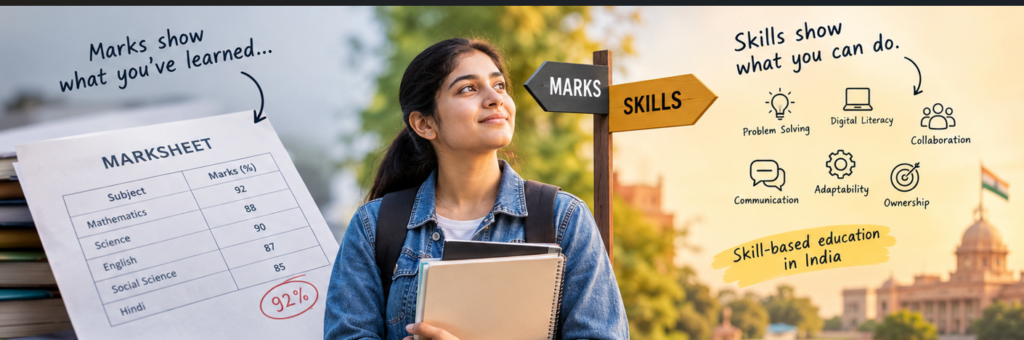
Consider the following. Marks demonstrate what you have retained. Skills illustrate what you can do with the information.
The theory is based on the concept of competence. Students develop through action. They construct projects, solve problems, and collaborate in teams. Examinations are not abolished but no longer serve as the sole measure.
Here is what it usually includes:
- Project work instead of only theory
- Internships and live assignments
- Vocational training from school level
- Short courses and certifications
- Assessment of communication, thinking and teamwork
Why the Shift from Marks to Skills in Education Is Happening
The truth is that no one expected it all to happen in such a manner. This came about because of certain issues. There are many graduates having difficulty getting employed. It seems that firms have trouble employing those who are ready for employment.
The ability to apply it is missing. Skill-based education in India aims to close that gap. At the same time, work is changing fast. Tools change every year. A fact learned in college may be outdated in three years. But the ability to learn quickly never gets old.
This is the essence of the move from marks to skills in education. Memory is cheap today. A mobile phone can answer most factual questions. But what is not so common is judgment, creativity, and effective communication.
What Is Driving the Change
Three forces are working together.
1. Policy support. The National Education Policy 2020 gave skill-based education in India real backing. It pushed for vocational exposure, flexible learning paths and less rote learning. It also encourages internships and credit systems that count real-world work.
2. Employer demand. Many hiring teams now run skill tests and project reviews. Some value a good portfolio over a high percentage.
3. Technology. Online platforms made learning cheap and open. A student in a small town can now learn coding or design from anywhere.
Skill-Based Learning for Students: What Actually Counts
Not every skill is equal. Some travel well across careers. Start with these.
- Communication: Can you explain an idea in two clear minutes?
- Problem-solving: Can you break a messy problem into small steps?
- Digital literacy: Can you use data, spreadsheets and basic AI tools well?
- Collaboration: Can you work with people you did not choose?
- Learning agility: Can you pick up a new tool in a week?
- Ownership: Can you finish what you start?
Notice something here. These are the core of skill-based education in India. None of them needs a special degree. They can be practised in any course, in any college.
A Fresh Idea: Build Your “Skill Receipt”
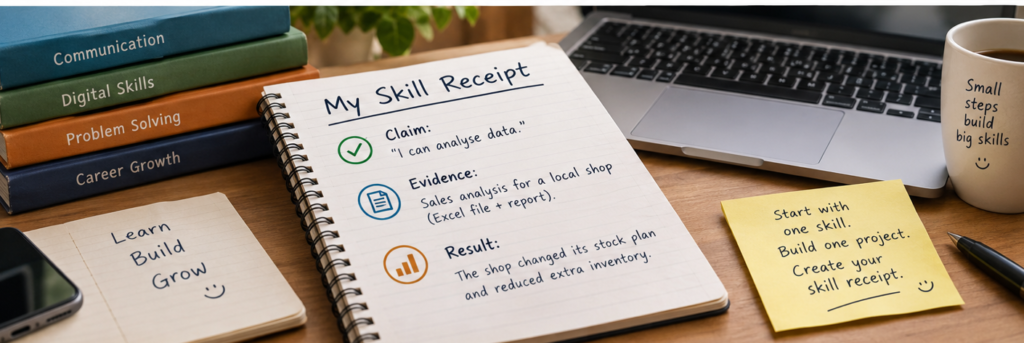
This is one thing that most blogs fail to consider. Marks have a receipt. That is your marksheet. Skill has no receipt unless you create one. Create one for yourself. Skill receipt is just a one-page proof. There are three main elements for each skill:
- Claim: “I can write clear reports.”
- Evidence: A link, file or project that shows it.
- Result: What changed because of it.
For example, a commerce student may claim “I can analyse data.” Evidence: a small sales analysis for a local shop. Result: the shop changed its stock plan. This one page can do more than a long resume. It turns skill-based education in India from a slogan into something you can show.
How Students Can Start Right Now
You do not need to wait for your college to change. Here is how to begin on your own. Start small.
- Pick one skill per quarter. Not ten. One.
- Build a tiny project. Make a blog, a budget tracker or a short video.
- Ask for feedback. Show your work to a teacher or senior.
- Keep a learning log. Note what you tried and what failed.
- Do short courses wisely. A certificate without a project means little.
Remember, skill-based education in India does not replace marks. Marks still matter. They open some doors, like entrance exams and shortlists. The smart move is to carry both. Keep your grades healthy and build skills beside them.
What Parents and Teachers Can Do
This cannot be done by students alone. The home and the class play a critical role. The parent can now pose a different question during dinner: “What have you built today?” rather than “How well have you scored?” This is just a simple change, but it completely changes the whole way of thinking. The teacher can make sure that every unit has one practical assignment. This could be a case study, a presentation, or solving a problem.
The Challenges We Should Not Ignore
This change is not perfect. Skill-based education in India faces real hurdles. Let’s talk about them.
- Uneven access: Rural and low-income students may lack labs, internet or mentors.
- Teacher training: Teachers need support to teach and assess skills.
- Fair assessment: Judging a skill is harder than checking an answer.
- Certificate chasing: Some students collect badges without real learning.
These gaps are fixable. But they need honest attention, not just good slogans.
The Future of Education in India
So where is this going? The future of education in India will likely look more flexible. Students may mix subjects, earn credits from different places and learn throughout life.
Skill-based education in India will shape that future. Degrees will not vanish. They will share the stage with portfolios, projects and verified skills. A student’s story will matter as much as a student’s score.
The winners will be curious learners. People who keep updating themselves. People who can show their work. That is where the shift is quietly heading.
Conclusion
Marks show part of your journey, but skills show what you can do in real life. Skill-based education in India does not suggest that examinations will be rendered unnecessary. What it does imply is the integration of theoretical studies with practical skills. First, pick up one practical skill, undertake a project, and then prove your mettle.