
Planning to study in Canada for Indian students in 2026? Get costs, admission steps, and visa tips in this easy Canada study guide.
Introduction
Do you wish to pursue your studies in Canada? Great decision but 2026 is not the same as 2023.
Things have changed. The fees have increased. The visa process has become stricter. If you go ahead using outdated information, then chances are that you might get yourself stuck somewhere.
Here we have an updated Canada study guide for Indian students. This is an honest, updated Canada study guide for Indian students. Just what you need to know right now, for anyone serious about the study in Canada for Indian students journey.
Why Canada Is Still Worth It (Even With Tougher Rules)
Canada has always been a preferred choice among Indian students for many years now. This is something that has not changed.
What has changed is the way you can get there. The Student Direct Stream option is no longer available. It shut down back in November 2024. All Indian students have to apply under the normal stream which typically takes between 3 and 12 weeks.
The important thing you probably don’t know is this: it’s not all doom and gloom. Everyone’s under the same conditions now.
If you’re serious about your plan to study in Canada for Indian students’ pathways to work and settle, 2026 actually rewards preparation more than luck.
Cost of Studying in Canada: The Real Numbers
Let’s talk money first, because this is where most students get surprised.
Living costs:
- You now need to show proof of CAD 22,895 per year just for living expenses. That’s higher than before.
- This does not include your tuition. It’s on top of it.
Tuition costs:
- Undergraduate programs: roughly CAD 15,000 to 35,000 per year
- Master’s programs: roughly CAD 20,000 to 45,000 per year
- Specialised programs like MBA can go even higher
Total yearly cost:
- Add tuition, living expenses, and travel, and most Indian families are looking at somewhere between INR 19 lakh and 50 lakh a year, depending on the city and college.
A quick tip: Toronto and Vancouver are pricier. Smaller cities like Winnipeg or Regina cost noticeably less. If your budget is tight, don’t rule out these smaller cities. Many have solid colleges and lower rent.
Bank statement checkpoint:
Immigration officers now dig deeper into where your money came from. It’s not enough to just have the funds sitting in an account. You need to show:
- Six months of clean bank statements
- Proof the money is genuinely yours or your sponsor’s
- No sudden, unexplained large deposits right before applying
This single point trips up a lot of applicants. Don’t rush your finances. Start organising them months in advance.
How to Study in Canada: Step-by-Step
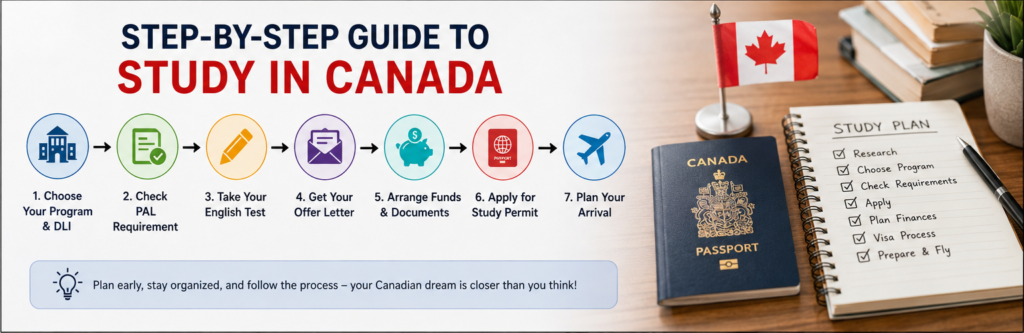
Here’s where most guides get vague. Let’s not do that. This is the exact process to study in Canada for Indian students, broken into simple steps.
Step 1: Pick your program and check the DLI status
Only apply to programs from Designated Learning Institutions. The important point in regards to 2026 is that you have to take only those programs from Public Designated Learning Institutions if you wish to pursue your career in Canada in future.
Step 2: Check if you need a Provincial Attestation Letter (PAL)
This is relatively new, but things just got easier for some students. Starting January 2026, applications for Master’s and PhD studies at public universities will be exempted from PAL requirements completely. You will still require a PAL if you are applying for your bachelor’s degree.
Step 3: Take your English test seriously
IELTS or any other equivalent test is absolutely necessary. In order to qualify for the PGWP in future, master’s degree graduates need to score around CLB 7, which is approximately IELTS 6.0 in all bands. Do not settle just for “passing.”
Step 4: Get your offer letter
Apply early. Popular programs fill up fast, and a late application often means a weaker chance at scholarships too.
Step 5: Arrange your funds and documentation
Refer back to the cost section above. Get your finances sorted well before you apply for your study permit.
Step 6: Apply for your study permit
This marks the last major phase. Processing currently takes between 3 and 12 weeks via the normal channel. Applications for admission to Ph.D programs from non-Canadian locations may benefit from priority processing within 14 days.
Step 7: Plan your arrival
Book housing before you land, if possible. Don’t wing this part — it’s stressful enough as it is.
Canada Admission Process for Indian Students: What’s Actually Different in 2026
If you’ve read older blogs, some of this will surprise you.
- Refusal rates have increased. The refusal rate for undergraduate applications submitted from India reached 74% in August 2025, which is significantly higher than the 32% observed two years ago. This does not mean that you should panic, but it does mean that your paperwork must be impeccable.
- The requirement of genuine student took the place of the old check on genuine temporary resident. It implies that your study plan must be evaluated much more critically.
- The number of study permits issued is decreasing. The goal for Canada’s 2026 is 408,000 study permits, of which only some will be reserved for first-time applicants. Less space means increased competition.
- The PGWP requirements are stricter. The importance of graduation from a public university has never been more critical to earn your postgraduate work permit.
Here’s my honest take: none of this should stop you from applying. It should just make you more careful. A well-documented, genuine application still has a strong shot.
Quick Tips Before You Apply
- Don’t overdo your intentions. Police will know when your plans don’t correspond to your work experience.
- Take into account budget issues when choosing your city; a decent university in an affordable city is better than an average university in an expensive city.
- Collect your financial papers months in advance.
- Before you fall for the pictures of the campus, find out if your program takes place at a public or a private DLI.
- Always have an explanation for each document. For example, if there are transfers between accounts, be ready to explain why.
Following this Canada study guide for Indian students step by step will save you from the most common rejection reasons.
A Quick Word on Post-Study Plans
A lot of Indian students choose to study in Canada for Indian students’ most valued outcome — the pathway to work and eventually settle. That’s fair. Just go in with eyes open.
The graduates of the public DLI still have the privilege of getting a PGWP lasting up to three years. The graduates of private colleges no longer have such privileges. In light of the fact that long-term settlement is an important concern, the choice of college is critical.
Conclusion
Canada is still a strong choice in 2026. The path is just narrower than before.
Get your documents right. Pick a public DLI. Start your funds early. Follow the steps, not the shortcuts. That’s really the whole secret behind a smooth study in Canada for Indian students application.
Do that, and your plan to study in Canada for Indian students in 2026 has every chance of working out.