
Confused about online degree vs regular degree in 2026? Compare cost, recognition, flexibility, and career impact for Indian students before choosing a degree.
Introduction
Confused about an online degree vs regular degree? You’re not alone.
Each year, millions of students in India encounter the same dilemma. However, in 2026, the decision has become even more difficult. Online degrees have become more trustworthy. Degrees have not lost their value. But which one should you opt for? Parents want to know. Professionals ask this too. Even toppers from schools want to know before admissions begin. But most of the available information is vague or partial.
Let’s examine both degrees rationally. Point by point. No unnecessary talk. Only useful information to help you make your decision.

Online Degree vs Regular Degree: Why 2026 Changes the Game
A few years back, this decision was simple. Regular degree meant respect. Online degree meant doubt.
That’s changing fast.
Here’s why:
- Online degree programs are now available from the top-ranking universities, not only distance education programs by UGC
- IITs, IIMs, and central universities have joined the field of online degrees
- The hiring criteria have now become skill-based and not related to mode of instruction for tech companies, financial institutions, and startups
- Hybrid work culture has helped in accepting flexible learning
None of this happened overnight. It took new UGC guidelines, better internet infrastructure, and years of pressure from working students who needed a real alternative to campus life.
So the online degree vs regular degree debate today isn’t about which one is “fake” and which is “real.” It’s about fit. Your goals decide the winner, not the format alone.
What Counts as a Valid Online Degree in India Right Now
All online degrees are not made equal. This is where the mistake lies for most students.
According to UGC, any university offering online degrees must have NAAC accreditation above 3.26. This is different from the requirement of distance education.
Before you enroll anywhere, check:
- Is the university UGC-entitled for online degrees? (Check the official UGC list, not the college website)
- Does the course appear on the university’s approved online program list?
- Is the degree issued as “online,” not vaguely labelled “distance” or “correspondence”?
This one check alone solves half the confusion around online degree vs regular degree in India. A lot of “online degree” scams exist simply because students never verify this list.
What a Regular Degree Still Gives You
A regular degree isn’t just a piece of paper. It’s an experience.
Campus life builds things a screen can’t:
- Actual internships, not only online applications
- Projects that help learn real teamwork
- Individual mentoring by faculty members
- Mobility drives with recruiting officials
- Lifelong friends and contacts
Consider an interview. An applicant who had been introduced in seminars, engaged in debates and completed an actual internship looks much more confident. This confidence cannot be gained through watching video lectures.
For young people straight out of 12th grade, this is even more important than they think.
Online Degree vs Regular Degree: Cost Comparison and Real Value
Money matters. Let’s talk numbers, roughly.
- Regular degree (private college, India): ₹1 lakh to ₹4 lakh per year, plus hostel and travel
- Online degree (UGC-entitled university): ₹15,000 to ₹80,000 per year, no hostel cost
On paper, online degrees look cheaper. And they are, upfront.
But factor in what you’re not getting: campus placements, internship stipends through college tie-ups, and networking that often leads to higher starting salaries. For some careers, that gap pays back the extra cost of a regular degree within the first year of a job.
For working professionals already earning, the math flips. An online degree makes far more sense there.
Online Degree vs Regular Degree: The Career Angle That Actually Matters
This is the part students underestimate.
Some careers simply demand physical presence. You cannot learn these through a screen:
- Engineering (labs, workshops, technical training)
- Medicine, Nursing, Pharmacy (clinical and practical exposure)
- Law (moot courts, courtroom practice)
- Design and Architecture (studio-based learning)
For these fields, a regular degree isn’t optional. It’s the only real path.
But for fields like:
- Business management
- Computer applications
- Commerce
- Humanities and Arts
…an online degree from an accredited university can be equally useful for you, particularly if you are developing your abilities via certifications at the same time.
This is what actually separates an online degree from a traditional one in terms of its value. It has nothing to do with which looks more impressive in your CV. The point is whether or not your profession requires practical training.
There is also a compromise solution that will become popular in 2026: hybrid or blended degrees. They combine online courses with occasional on-campus programs for labs, exams, or internships. In case if your university has such an option, it will provide you with the benefits of both options.
Online Degree vs Regular Degree: Who Should Choose What
Here’s a quick gut-check.
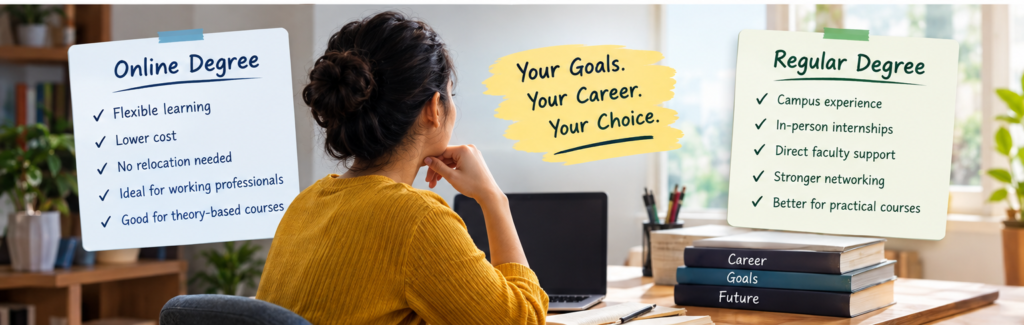
Pick an online degree if you:
- Are already working and need flexibility
- Are preparing for competitive exams alongside studies
- Live far from a good college and can’t relocate
- Are pursuing a theory-heavy course
Pick a regular degree if you:
- Just finished 12th grade
- Want to pursue engineering, medicine, law, or nursing
- Need campus placements and internships
- Want a structured, guided learning environment
There’s no universal right answer here. Only the right answer for your situation.
Before You Enroll: Red Flags to Watch For
A lot of students get burnt by fake online degrees. Watch out for:
- Universities not listed on the official UGC online degree list
- Courses promising a degree in unusually short timeframes
- Websites with no clear accreditation details
- Agents pushing you to “enroll today” without letting you verify anything
Choose an evening. Verify the UGC list on your own. Nothing beats a guarantee made by an agent.
Also, ask one straightforward question to the university – how many students out of last year’s online batch were actually placed or promoted? A definitive answer is far more convincing than brochures.
The Bottom Line
The online degree vs regular degree fight isn’t about winners and losers anymore. This pertains to choosing a mode that suits your age and career aspirations. A person who works is likely to benefit more from flexibility. A newly qualified student who has passed 12th is likely to get more out of being on campus. Ensure you check the UGC list first.