
Discover the best AI tools for academic research in 2026 — from paper discovery to writing help — and build a smarter, faster research workflow.
Introduction
Come to terms with it. Academic research once entailed long hours spent in the library, poring over PDF files, and trying to figure out which paper contains which content. But those days are long gone.
As of 2026, AI tools for academic research are a student’s best-kept secret. But most guides just list the names. Elicit. Consensus. NotebookLM. Good, what next?
This blog is different. We’re not just listing tools. We’re showing you how to stack them so your research actually gets faster, not more confusing. By the end, you’ll know exactly which AI tools for academic research to use at each stage of your project — and which mistakes to avoid.
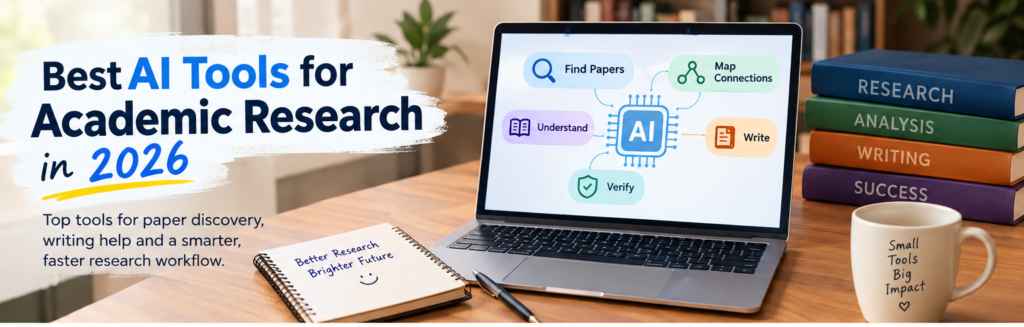
Why Every Student Needs AI Tools for Academic Research Now
Here’s the truth: the students who struggle most aren’t the ones without access to good sources. They’re the ones drowning in too many sources with no system to sort them.
That’s exactly the gap that AI tools for academic research are built to close. They don’t replace your thinking. They clear the noise so your thinking has room to work.
A few reasons this matters more in 2026 than ever before:
- The pace of journal publication is faster than anyone’s ability to read
- The new requirement by universities is for you to reveal how AI was applied, meaning you have to master that skill as well
- Exams and thesis defense boards value both speed and depth of analysis
If you’re a student in India prepping for a dissertation, a competitive exam essay, or a study-abroad application essay, this is exactly where AI tools for academic research earn their keep.
The Fresh Angle: Think in Stages, Not Tools
Most blogs list ten tools and call it a day. That’s backwards.
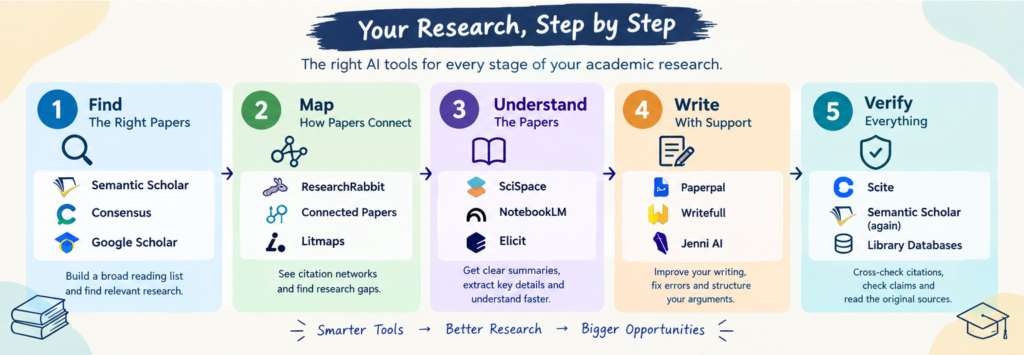
Every research project moves through five stages: find, map, understand, write, and verify. The smartest way to pick AI tools for academic research is to match one tool to each stage — not to hunt for one tool that does everything. Nothing does everything. Not yet.
Here’s your stage-by-stage stack.
Stage 1: Finding the Right Papers
This is where most students waste the most time. Don’t just Google it.
- Semantic Scholar — great for building a broad reading list and spotting influential citations
- Consensus — best when you have a focused question and want an evidence-backed, quick answer
- Google Scholar — still solid for a first sweep, especially for Indian university topics
Tip: start broad with Semantic Scholar, then narrow with Consensus once you know your angle.
Stage 2: Mapping How Papers Connect
Once you have a stack of papers, you need to see how they talk to each other.
- ResearchRabbit — visually maps related papers so you spot gaps in the literature
- Connected Papers — shows citation networks in a simple graph
- Litmaps — helps you track whether you’re missing a major research strand
This step is often skipped by students in a hurry. Don’t skip it. It’s how you find your unique angle instead of repeating what’s already been said.
Stage 3: Actually Understanding the Papers
Reading dense academic language is exhausting. This is where AI genuinely saves hours.
- SciSpace — breaks down jargon-heavy sections into plain language
- NotebookLM — lets you upload your own sources and ask questions grounded only in them, so it won’t wander off and make things up
- Elicit — pulls out methods, sample sizes, and results across multiple papers at once, side by side
Stage 4: Writing With Support, Not a Ghostwriter
This is the stage where students get into trouble. Use these tools to sharpen your own writing — not to write for you.
- Paperpal — checks academic tone and catches citation-style errors
- Writefull — polishes sentence-level academic English
- Jenni AI — helps structure arguments while keeping your voice intact
Your professor or reviewer can usually tell the difference between AI-polished writing and AI-generated writing. Stay on the right side of that line.
Stage 5: The Step Everyone Skips — Verification
Here’s something most blogs won’t tell you plainly: general chat-based AI tools can invent citations that sound completely real but don’t exist. This isn’t rare. It happens often enough that skipping this step is genuinely risky.
- Cross-check every citation on Semantic Scholar or your university library database
- Use Scite to see whether a paper has actually been supported or contradicted by later research
- Never submit a citation you haven’t opened and read yourself
Treat this as non-negotiable. The best AI tools for academic research still need a human checking their work.
A Simple Weekly Workflow You Can Copy
Here’s how a smart student might actually structure a week using AI tools for academic research:
- Monday: Discovery sweep with Semantic Scholar and Consensus
- Tuesday: Map connections with ResearchRabbit
- Wednesday–Thursday: Deep reading with NotebookLM and Elicit
- Friday: Draft sections using Jenni AI and Paperpal
- Saturday: Verify every single citation by hand
Notice what’s missing from that list? A general chatbot doing everything. That’s on purpose. AI research tools 2026 work best as a team, not a single all-in-one shortcut.
Common Mistakes to Avoid
A few traps we see students fall into again and again:
- Relieving on the citation provided by the chatbot without checking the original paper
- Using the same tool throughout the process rather than using different tools for each stage
- Failing to acknowledge AI usage if the university requires it
- Allowing the AI to do the arguing instead of structuring the argument only
This is much more important than choosing which exact tool to use.
Who Benefits Most From These Tools?
- Students at the undergraduate level dealing with many assignments and time pressures
- Postgraduate and PhD candidates working with a large number of references for a literature survey
- Candidates preparing for competitive exams requiring immediate and dependable background information
- Study abroad candidates writing a statement of purpose with a lot of research involved
Whether you’re a student figuring out AI tools for students or a full-time researcher exploring AI tools for researchers, the stage-based approach works the same way.
Final Thoughts
There’s no single winner among AI tools for academic research in 2026. The true art is knowing which tool is required for each phase and the discipline to make sure everything is checked out before it gets into your final draft.
It all starts with choosing just one tool for each phase. Practice makes perfect. You’ll be able to conduct research faster, better, and even more uniquely.