Introduction
Here’s a basic fact. Your degree gets you an interview. But it’s your skills that get you the job. AI is an inevitable aspect of study tables and office spaces in 2026. It permeates through notes, research, designing, coding, marketing, and finance. So which AI skills for students in 2026 actually matter? And how do you build them without burning out?
That is what this guide is about. No heavy jargon. No tool overload. Just ten practical skills, with a small task for each one. You can start today.
Why AI Skills for Students Matter Right Now
Imagine AI as the Internet of 2000s. No one ever asks themselves, “Do I need to learn how to use it?” People just start using it. Early adopters progress quickly. This is exactly the situation we are experiencing right now. Modern recruiters expect candidates to have at least some level of familiarity with AI. They don’t expect people to create models; they want people to use it wisely and ethically.
Here is what good AI skills for career growth give you:
- Faster research and cleaner assignments
- Better projects for your resume
- More confidence in interviews
- A clear edge over students who only “play” with chat-bots
Let us get into the list of AI skills to learn in 2026.
1. Prompt Writing
A prompt is just your instruction to the AI. A vague prompt gets a vague answer. A clear prompt gets a useful one.
A good prompt has four parts:
- Role: Who should the AI act as?
- Task: What do you want done?
- Context: What should it know?
- Format: How should the answer look?
Try this today: Ask AI to explain photosynthesis in five lines for a Class 9 student. Then ask again with a role and a format. Compare both answers.
2. Fact-Checking AI Answers
AI sounds confident even when it is wrong. It can invent facts, dates and even sources.
This is why checking is a core skill. Smart students never copy and paste blindly.
- Verify every number and date
- Open the source it gives you
- Cross-check with a textbook or an official website
Try this today: Ask AI for three statistics on your favourite subject. Now verify each one. See how many hold up.
3. AI-Assisted Research
Research meant twenty open tabs. But now that AI is able to filter and summarize in minutes, why not use it? Use it only as a guide. Use it only to lead you to certain concepts. Read the actual papers and reports yourself.
- Ask AI to break a big topic into smaller questions
- Use it to summarise, then read the original
Proof you can show: A short research note where you list AI-found ideas and the sources you personally verified.
4. Data Literacy
Where is there no data? Marks, surveys, sales, social media figures. Someone has to interpret it. You don’t have to be an Einstein at math. All you have to do is be able to understand charts and patterns. AI can help you clean your data and create basic charts.
- Learn basic spreadsheet skills
- Understand averages, percentages and trends
Try this today: Take your last semester’s marks. Ask AI to help you chart them. What pattern do you see?
5. Writing and Editing with AI
AI can help with writing. However, it cannot emulate your writing style. Your style is what makes you unique. You can use AI for checking your grammar and making your sentences more concise and structurally correct. After that, rewrite it yourself.
- Write your first draft yourself
- Use AI to review, not replace
- Always add your own examples
Tip: If your writing sounds like everyone else’s, you have leaned on AI too much.
6. No-Code Automation
Tasks that need to be done every week include renaming of documents, sorting out emails, and following up on deadlines. Such activities can be automated without coding.
No-code tools integrate applications and use artificial intelligence to perform tedious tasks. This is one of the least understood skills of the future among students.
Try this today: Set up a simple flow that saves every new assignment reminder to one sheet. Small win. Big habit.
7. Understanding How AI Works
You do not need a PhD. You need a basic map.
Know these ideas in simple words:
- Training data: What the AI learned from
- Bias: Why answers can be unfair
- Hallucination: When AI makes things up
- Limits: What it cannot do well
When you understand the “why,” you trust AI the right amount. Not too much. Not too little.
8. Responsible and Ethical AI Use
This is one of the AI skills for students that protects you. Many colleges now have AI-use rules. Break them, and you may face serious trouble.
Follow simple rules:
- Read your college’s AI policy
- Never upload private data or ID documents
- Mention when AI helped you, if required
- Never submit AI text as your own
Employers notice this too. Honest students are trusted faster.
9. Creating Visuals and Presentations with AI
The idea is important, but how it is delivered is also important. AI can assist with presentation creation – slides, posters, small videos, and design, but the taste of the creator is what makes it all happen.
Try this today: Turn one class topic into a five-slide deck. Use AI for layout ideas. Add your own examples and edit every line.
10. Learning How to Learn with AI
This is the skill behind all other AI skills for students. Use AI as a patient tutor, not a shortcut.
- Ask it to explain a topic like you are twelve
- Ask it to quiz you, then explain your wrong answers
- Turn long notes into flashcards
- Build a revision plan for your exams
Students who learn this way study smarter, not longer.
Which AI Skills for Students Should You Start With?
Not sure where to begin? Pick based on your stream.
- Commerce: Data literacy, no-code automation, AI-assisted research
- Arts and humanities: Writing with AI, fact-checking, ethical use
- Science and engineering: How AI works, data literacy, prompt writing
- Media and design: Visual creation, prompt writing, fact-checking
Whatever your stream, always start with prompts, fact-checking and ethics. These three work everywhere.
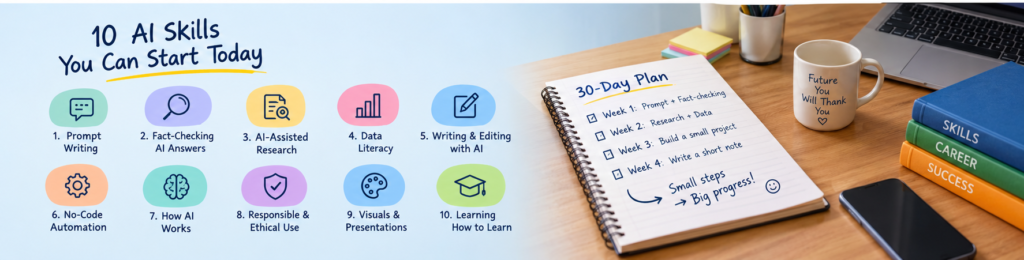
Your 30-Day Plan to Build AI Skills for Students
Do not try everything at once. Build your AI skills for students step by step.
- Week 1: Practice prompt writing and fact-checking daily, ten minutes each
- Week 2: Do one research task and one data task
- Week 3: Build one small project, like a deck, a chart or an automation
- Week 4: Write a short note on what you built and how AI helped
Save each piece. After 30 days, you will have a mini portfolio. That is your proof.
Common Mistakes While Learning AI Skills for Students
- Chasing every new tool instead of learning the basics
- Trusting AI answers without checking
- Copying instead of understanding
- Hiding AI use when your college expects honesty
Final Thoughts
AI will never replace the students that have learnt how to leverage it. It will replace the ones that refuse to use it. Think small. Choose any two AI capabilities students must learn this month. Practice them every day. Share what you did. The best time to build AI skills for students was last year. The second-best time is today.