
Looking for government jobs after graduation? Explore top exams like SSC CGL, banking, railways and UPSC, plus a simple 12-month study plan.
Introduction
You are now holding your degree. What next? Every family member has something to say. Every WhatsApp group has a “sure-shot” trick. It can get pretty confusing!
I have been writing about careers for more than a decade now. There has been one constant throughout all these years. Sarkari naukri continues to be among the most reliable career options in India. If you are exploring government jobs after graduation, the real problem is not finding exams. It is choosing the right one. This guide will help you do that. No jargon. Just clear picks.
Why Government Jobs After Graduation Still Make Sense
Let us be real. Private jobs can be exciting. But they can also feel shaky. Layoffs happen. Targets keep rising.
Here is why many graduates still choose a sarkari naukri:
- Job security. Once confirmed, your post is stable.
- Predictable pay. Salary and allowances follow a clear structure.
- Set working hours. Most roles offer better work-life balance.
- Respect. You serve the public, and people notice that.
- Long-term benefits. Rules differ by post, so always read the notice.
None of this makes private jobs bad. It just means you should compare both with open eyes.
Government Exams After Graduation: The Big Picture
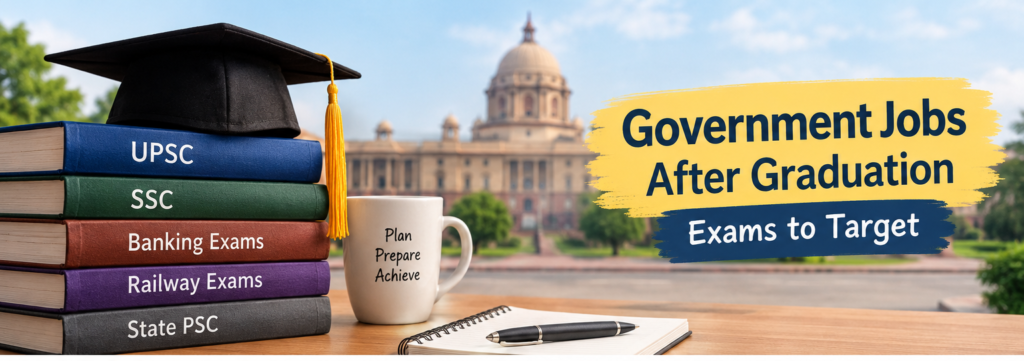
Think of government jobs after graduation as five lanes. Each lane has its own pace.
- SSC lane: Central government offices. Mostly a graduation degree is enough.
- Banking lane: Public sector banks and RBI-linked bodies.
- Railway lane: Huge hiring. Many posts open every year.
- Civil services lane: UPSC and state PSC. Long game, big reward.
- Insurance and regulator lane: Officer-level roles in insurers and bodies like NABARD.
Pick one lane first. Then pick one exam inside it. That one decision saves you months.
Best Government Jobs for Graduates: Where to Start
Which are the best government jobs for graduates? It depends on you. Government jobs after graduation suit different people. Government positions for graduates in India come out every month. However, certain positions continue to appear on every aspirant’s list.
- Positions of Assistant Section Officer and Inspector through SSC
- Posts of Probationary Officer (PO) in Banks
- Railway positions in commercial and clerical
- Positions of Administrative Officer in Insurance Companies
- IAS, IPS and State Civil Services Posts
There are separate pay, posting and promotion scales associated with each position. Age criteria is also separately decided for each position. Do not believe any forward message before seeing the official notification.
SSC CGL Exam: The Graduate’s Favourite
The SSC CGL exam is the first name most graduates hear when they search for government jobs after graduation. And for good reason.
Here is what happened in 2026:
- The notification came out on 21 May 2026.
- It announced 12,256 vacancies.
- Tier 1 was planned for August to September 2026.
- Tier 2 is planned for December 2026.
However, during the 2025 cycle there were approximately 14,582 vacancies. So numbers can fluctuate each year. This is why you should never wait for the “perfect” year.
The test consists of two levels. No interview process. Majority of posts consider candidates with a degree in any stream. Normal age requirement is between 18-32 years, although it may vary according to the post. If you have missed this cycle, you should begin right away for the next cycle.
Banking and Railway: Government Jobs After Graduation
Now let us look at government job exams after graduation beyond SSC.
Banking
- IBPS PO and SBI PO are the big names.
- Both usually look for graduates around 20 to 30 years old.
- The selection has prelims, mains and an interview.
- Reasoning and quant need steady daily practice.
Railways
- RRB NTPC is open right now, with 5,236 posts listed.
- The age range is 18 to 33 years.
- The last date is 13 November 2026.
- Some NTPC posts need only 12th pass, but graduate posts pay more.
These dates came from a job-portal listing. Confirm them on the official RRB website.
Live Deadlines This Week: What Graduates Can Still Apply For
Here is something most blogs skip. Deadlines. As of 22 October 2026, a few government jobs after graduation still have open forms, and some close very soon:
- Bihar BTSC FSO: 105 vacancies, deadline 24 October 2026
- NICL AO: 321 vacancies, deadline 28 October 2026, age 21 to 30 years
- RRB NTPC: deadline 13 November 2026
Filling an application does not cost much. It takes a small fee and time. Even when you are not fully prepared, you get an actual test to practice on from the form. There is no better training than this.
UPSC and State PSC: The Long Game
Civil Services Exam of UPSC is not an easy one to crack. It is by far the most difficult exam from the above list. It requires patience. However, it offers you policymaking positions too.
- The exam has prelims, mains and an interview.
- The general category age range is 21 to 32 years, with six attempts.
- Many aspirants prepare for two to three years. That is a long road, but government jobs after graduation do not get bigger than this.
Exams for State Public Service Commission follow suit on a state-wide level. The syllabus and age requirements vary depending upon each state. If you wish to make your home state your destination, this is an ideal choice.
Competitive Exams After Graduation: Pick by Your Stream
Not all competitive exams after graduation suit every degree. Here is a simple filter:
- BA graduates: SSC CGL, UPSC, state PSC, banking
- BCom graduates: Banking, insurance AO, SSC auditor posts
- BSc graduates: SSC CGL, banking, food safety and technical posts
- BTech graduates: Engineering departments, SSC and RRB technical posts
- Law or media graduates: State judicial services, civil services, information services
Stream does not lock you in. It only gives you an edge in some exams. Government jobs after graduation stay open to almost every degree holder.
12-Month Plan to Crack Your Target Exam
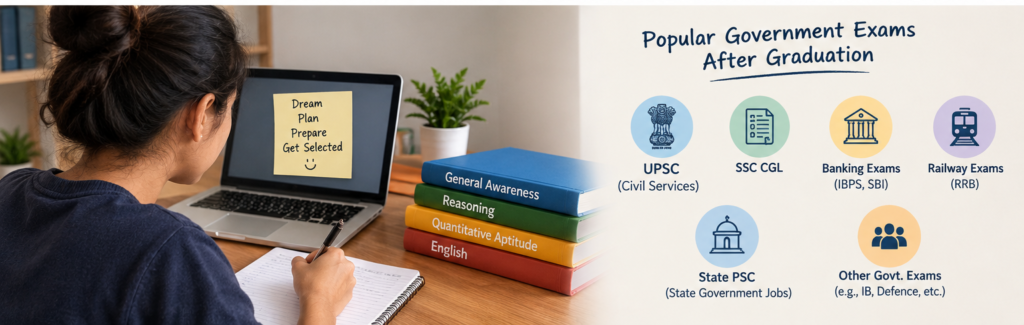
Most aspirants fail because they have no plan. Not because they lack talent. Here is a simple 12-month structure:
- Months 1 to 2: Read the syllabus of three exams. Find what overlaps.
- Months 3 to 6: Build basics in maths, English and general awareness.
- Months 7 to 9: Take one full mock every week. Review every mistake.
- Months 10 to 12: Apply widely. Sit as many exams as you can.
Use the anchor, stretch, safety rule for government jobs after graduation. Select one anchor test such as SSC CGL. Select one stretch test such as UPSC. Select one safety test such as the state-level exam. This helps you continue even if any one of them fails.
Mistakes That Cost Aspirants a Full Year
I have seen these again and again:
- Switching exams every month
- Collecting ten books and finishing none
- Skipping mocks until the last week
- Ignoring the official notification
- Studying alone for 14 hours but never revising
Fix these five things first. Your marks will improve before you add a single new topic.
Final Thoughts
Preparing for government jobs after graduation requires consistency, patience, and a clear strategy. Select the tests that suit your tastes, aptitude, and future career. Prepare a realistic schedule for yourself, work on past question papers and maintain a check on application deadlines. Begin your preparation right away, set an aim, and start taking small steps to establish yourself in the government service.