
Explore the best countries for international students in 2026 — real costs, visa rules, work rights, and smart picks beyond the obvious list.
Best Countries for International Students in 2026: Where Should You Actually Apply?
Picking a country to study in feels huge. And honestly, it is huge.
You are not just selecting an educational institution. You are selecting the next few years of your life. This includes the cost involved, the troubles you may have with visas, and possibly the place where you will begin your career after graduation.
So let’s stop beating around the bush. This is a straightforward list of the best countries for international students in 2026. It also explains why they made the list, including factors you may not have considered before.
If you have been scouring through countless listicles on the best countries for international students, you are not alone. All of them offer you the same old and vague information. Not this one.
What Actually Makes a Country “Best” for Students?
Rankings love to throw around words like “top university” or “world-class education.” But that’s only half the story.
Here’s what really moves the needle:
- Right to work after the study period.
- Cost of living rather than only the cost of tuition shown in brochures.
- Approval rates for students from India.
- Right to part-time employment during the course of studies.
- Safety of international students and especially of those who are first-timers and live alone.
Keep these five in mind. They matter more than any glossy ranking chart.
The Best Countries for International Students in 2026
This next section breaks down each destination, one by one, so you can compare them side by side.
1. Germany
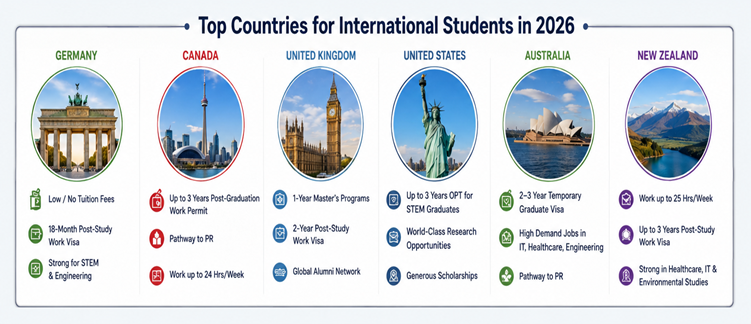
It is still one of the best countries for international students who need to pursue an excellent engineering or research program without being burdened with huge student loans. Public universities do not even charge any tuition fees. All you have to do is pay a minimal semester fee.
- Strong pull for STEM and engineering students
- 18-month post-study work visa after graduation
- Part-time work allowed for 140 full days a year
- German language skills help a lot, even in English-taught programs
The catch? Competition for spots is tough, and big cities like Munich aren’t cheap to live in.
2. Canada
Canada keeps showing up on every list of top countries for international students, and Indian students especially. It’s not hard to see why.
- Post-Graduation Work Permit lets you work for up to three years
- Clear pathway toward permanent residency
- Multicultural cities that feel welcoming from day one
- Off-campus work allowed up to 24 hours a week
Just budget carefully. Living costs in cities like Toronto or Vancouver add up fast, and visa processing has gotten stricter over the past couple of years.
3. United Kingdom
If speed matters to you, the UK is hard to beat. A master’s degree usually takes just one year instead of two. That’s one less year of tuition and one extra year of earning back home or abroad.
- Graduate Route visa gives two years of post-study work (three for PhDs)
- Deep alumni networks in business, law, and the arts
- Costs drop sharply outside London, think Manchester, Glasgow, or Leeds
The pound’s value can swing, so plan your budget with some cushion.
4. United States
The US remains one of the best countries to study abroad in 2026 simply because of scale. Thousands of universities, and scholarship money that genuinely changes lives.
- STEM graduates get up to three years of OPT work authorization
- Massive research funding and lab access
- Scholarships can cover a huge chunk of tuition if you apply early
Healthcare costs and visa uncertainty are the two things to watch closely here.
5. Australia
Australia has become one of the best destinations for international students from India without making much noise about it. It is not just the favourable climate that attracts international students. The Temporary Graduate visa also allows many graduates to stay and work in Australia for 2–3 years after completing their studies.
- Strong demand for healthcare, IT, and engineering grads
- Studying in a regional area can boost your permanent residency points
- Safe, laid-back lifestyle with a big South Asian community
Tuition can run high, especially for specialised master’s programs, so factor that into your planning early.
6. New Zealand
Small nation but powerful universities. New Zealand’s eight universities rank highly around the world. Students can work up to 25 hours per week during term time. After graduation, they can also obtain post-study work permits for up to three years.
It is not as widely recognized as its neighbours, such as Australia and Canada. However, students interested in healthcare, IT, and environmental studies should definitely consider it.
A Fresh Angle: Look Beyond the Usual Five
Here’s something most guides skip. If your budget is tight or competition in popular destinations feels overwhelming, consider emerging study abroad destinations for 2026.
- Ireland: English speaking country with big IT and pharmaceutical industries as well as a two-year post-study work visa for Master’s students.
- South Korea: Rising number of English programs, numerous scholarships from the Korean government, and thriving industries of technology and video games.
- Poland and Hungary: Low fees, EU-accredited degree, and relatively inexpensive cost of living compared to Western Europe.
These aren’t just backup options anymore. For students who want value without sacrificing quality, they’re genuinely competitive.
How to Actually Decide
Don’t just pick a country because your cousin went there or because it topped a list somewhere. Ask yourself:
- What’s your budget, realistically, including rent and food?
- Do you need strong post-study work rights, or is the degree itself the priority?
- Are you comfortable being far from home, or do you want a shorter flight back?
- Does the country have good placement records in your specific field?
Once you’re clear on your own priorities, narrowing down the best countries to study abroad in 2026 becomes a lot less overwhelming.
Final Thoughts
There’s no single “best” country. Out of all the best countries for international students we covered here, the right pick depends entirely on your budget, your field, and what you want your life to look like five years from now.
Germany and Canada score well on cost and stability. The US and UK score well on prestige and network. Australia and New Zealand score well on lifestyle and less competition. And if you’re willing to go, there are some rising stars out there like Ireland and South Korea that have plenty to offer.
So do your research, chat to students who have done it before you, and don’t restrict yourself to just one country. This is the key to actually getting it right.