
Paid vs unpaid internships: Compare stipends, learning opportunities, career growth, and experience to choose the right internship for your future.
Introduction
You get two offers. One pays a stipend. The other pays nothing, but the brand name is huge. Which one do you pick?
This is the question behind paid vs. unpaid internships. It affects many students in their second or third year. There is no right answer. However, there is a good method of making a decision. This guide provides an easy to understand list of pros and cons, an easy test, and five key questions to answer. Let’s begin.
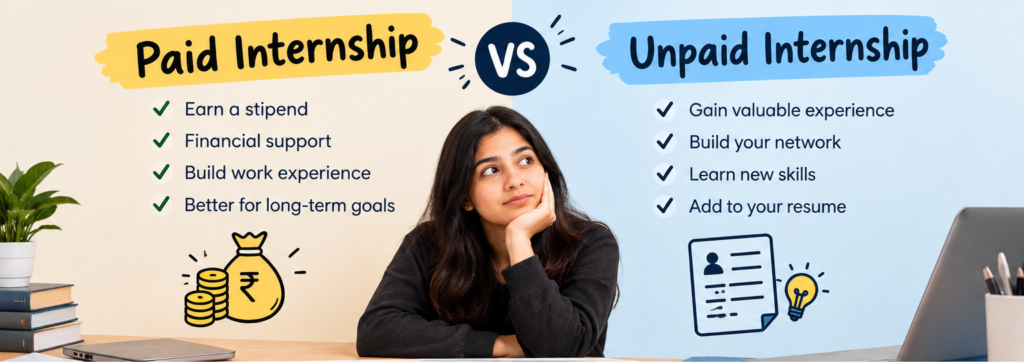
Paid vs Unpaid Internships: What Is the Real Difference?
It may appear to be simple when looked at on paper. A paid internship offers you a stipend or a salary while an unpaid internship offers you experience, a letter, and sometimes even a referral.
However, there is much more beyond just money here. Your payment alters the way you will be treated by the company. While a paying company wants you to be productive, it also lays out your job for you. On the other hand, the quality varies greatly in the case of non-paying companies. While some jobs are excellent, others are simply unpaid labour.
Therefore, do not make judgments based on the stipend alone.
Benefits of Paid Internships
Money helps. But the benefits of paid internships go beyond the stipend.
- Financial relief: You cover travel, food, and phone bills. You may even save a little.
- Real responsibility: Companies give paid interns actual tasks. You are not just making tea.
- Structure: Paid roles usually come with a manager, a plan, and feedback.
- Better job odds: In paid vs unpaid internships, firms that pay often want to keep you.
- Respect: You are treated like a team member, not a visitor.
Paid internships for students are also easier to defend in an interview. You can say, “I was hired for this work.” That sounds strong. It is one big reason paid vs unpaid internships are rarely seen as equals by recruiters.
Benefits of Unpaid Internships
Now, the other side. Unpaid does not always mean bad. The benefits of unpaid internships can be real in the right setting.
- Access to dream brands: Some top NGOs, media houses, and startups offer only unpaid roles.
- Flexible hours: You can often fit them around classes.
- Low entry barrier: Competition is lower, so you can get in with less experience.
- Niche exposure: Fields like journalism, research, and the arts often start this way.
- Academic credit: Some colleges count them toward your degree.
The catch? You must ask hard questions. Will I get a mentor? Will I work on real projects? If the answers are vague, walk away.
Are Unpaid Internships Worth It? Only If These 3 Things Are True
Are unpaid internships worth it? In paid vs unpaid internships, the answer is sometimes yes. But only when three things hold.
- You can afford it. If it forces you to borrow money, skip it.
- The learning is clear. You should be able to name three skills you will gain.
- The exit is strong. There should be a letter, a portfolio piece, or a referral at the end.
If even one is missing, think twice. Free work is only a good deal when you get something valuable back.
The Real Cost Check for Paid vs Unpaid Internships
This is one thing that most of the blogs will never tell you. Do this quick test before saying yes.
True cost = Travel + Food + Rent + Missed earning opportunities – Stipend
Consider this. Your internship is unpaid but located away from your place. You spend ₹200 per day on travel and food. So in 60 days you spent ₹12,000. Plus, there is the missed freelance work you could have done. Let us assume that is worth ₹10,000. Your total cost is ₹22,000.
Now you have a cost attached to that “free” internship. Question yourself – is it worth paying ₹22,000?
Paid vs Unpaid Internships Which Is Better? It Depends on Your Goal
So, which one wins? Match the answer to your goal.
- Need money now? Choose paid.
- Want a job offer? Choose paid. The odds are usually higher.
- Dream brand, tiny budget? Try unpaid, but keep it short. Four to six weeks is enough.
- Switching fields? Choose whichever gives you a real project to show.
- Building a portfolio? Pick the role with the best output, paid or not.
Notice the pattern. In paid vs unpaid internships, the best choice is the one that gives you proof of work.
The 5-Question Test Before You Accept
Ask these before you say yes:
- Who will guide me day to day?
- What will I own by the end? A report, a campaign, a design?
- How many hours a week will I work?
- Can I get a letter or a LinkedIn recommendation?
- What happens after? Is there a path to a job?
If you cannot get clear answers to at least four, say no politely. This test works for paid vs unpaid internships alike.
Red Flags to Watch For
Some offers are simply bad deals. Be careful if you see these:
- No letter of offer
- Full-time job without pay for several months
- Data entry and running errands without any training
- Not assigned any specific supervisor
- Asking for a payment to “ensure” an internship position (do not make such payments)
How to Turn an Unpaid Role Into a Paid One
Already in an unpaid role? You still have options.
- Decide on a short trial period, say four to eight weeks.
- Maintain a one-page list of achievements.
- Convince for a small allowance, or a least a travel and meals budget.
- Promise to take charge of one single project that yields measurable results.
Many managers say yes when you show value. Asking costs nothing.

Conclusion
Paid vs unpaid internships is not a fight to win. It is a choice to make with open eyes. Choose to pay for internships whenever possible. Only choose unpaid internships when the learning experience, branding value, and budget all match up. Do the cost calculation, ask the five questions, and trust your gut instinct. Time is valuable. Use it wisely.