
Is a degree enough to get a job in 2026? Learn what employers really look for, from job-ready skills to proof of work, and how to stand out.
Introduction
You worked hard for your degree. There were late nights, exams and endless assignments. Now you are applying for jobs, and a doubt creeps in. Is a degree enough to get a job in 2026?
Short answer: Not by itself, but it’s not totally useless either.
Consider your diploma a way into the building. It won’t get you into the meeting room, however. In this blog, you’ll find out what hiring managers are actually looking for. You’ll also discover a simple tool that you can begin implementing this very month.
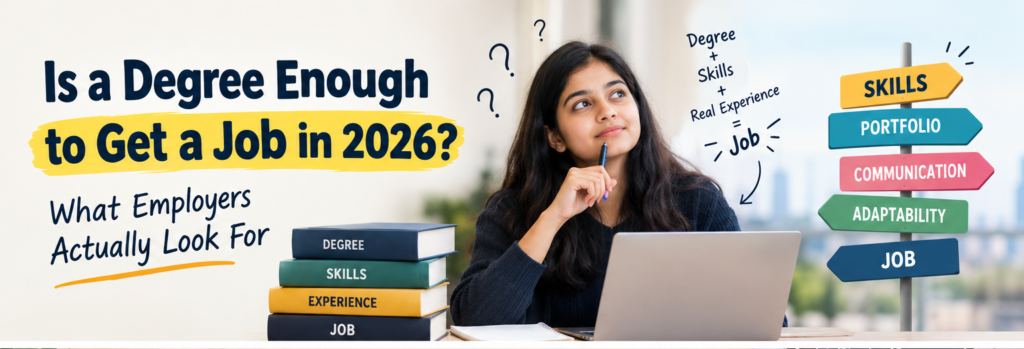
Is a Degree Enough to Get a Job? The Honest Answer
The degree is still relevant. Many firms use the degree as a screening criteria. A degree is compulsory for many government jobs and careers like law, medicine, and engineering. Hence, do not stop studying because of fear. However, the screening criteria have been altered.
Earlier, employers were ready to train new graduates. Today, they often prefer candidates who already have the skills to start contributing to the job. There are fewer people on the team. The manager does not have time to train everyone. Everybody is busy. Thus, the degree gets you in. But your competency allows you in.
Now, the recruiter asks one silent question: “Can this person do the job?” A degree alone cannot prove that you have the skills to do the job. But the proof will.
Degree vs Skills: Why the Gap Keeps Growing
This is the true challenge in the skills-versus-degree dilemma. Institutions impart good theoretical knowledge. Practical implementation is what jobs demand. This seldom overlaps. It takes several years for curriculums to be revised. New tools are introduced every few months in the workplace. This is the difference.
The dilemma of many students is, “Degrees or skills, which is more important?” I would like to say that this is an incorrect choice. It is not one or the other. It is about order. The degree makes sure your CV is noticed. Skills make sure you are selected. So, is a degree enough to get a job when tools and roles keep changing? Rarely. Skills fill the space your degree leaves empty.
Skills Employers Look for in 2026
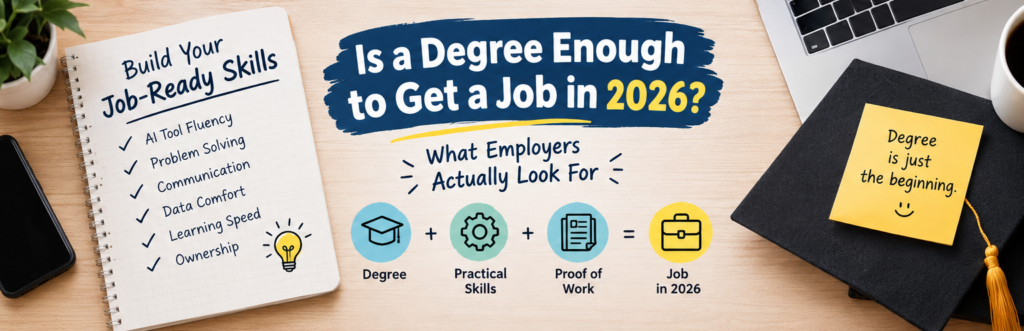
Let’s get specific. These are the skills employers look for in 2026, across most industries:
- AI tool fluency: You do not need to code. You need to use AI tools well and check their output.
- Clear writing: Emails, reports and messages. Short, clear and polite wins.
- Problem solving: Can you break a messy problem into small steps?
- Data comfort: Reading a basic chart or spreadsheet is now a baseline.
- Learning speed: How fast can you pick up a new tool?
Notice something. Most of these are not subjects in your marksheet. Yet they decide who gets the offer.
What Employers Look for in Candidates
Let’s go deeper. Here is what employers look for in candidates once the CV passes the first screen. They rarely say it out loud.
- Proof of work: A project, a portfolio, a live page or a case study.
- Consistency: A steady record beats a one-time burst of effort.
- Reliability: Do you reply on time? Do you show up prepared?
- Communication under pressure: Can you explain your thinking calmly?
Now, here is an insight from the perspective of hiring. An answer to the interview email provides a lot of information to a manager. It shows hesitation if you give an answer late and carelessly. You build up trust even before meeting if you give an answer quickly and clearly. Secondly, every time a manager hires someone, he takes a risk. It is your job to make this risk safe.
Job-Ready Skills for Students: A 90-Day Plan
You do not need a year. Start with 90 days. Here is a simple way to build job-ready skills for students:
Days 1 to 30: Pick one direction.
Choose one role you want. Read ten job posts for it. List the skills that repeat.
Days 31 to 60: Learn and build.
Take one short course. Then build one small project right away. Do not just watch videos.
Days 61 to 90: Show and share.
Put your project online. Write three lines on what you learned. Share it on LinkedIn. Ask two people for feedback.
That is it. Small steps, done in order.
Many students skip the build step. They collect certificates instead. But ten certificates without one project look weak. One project without any certificate looks strong.
Is a Degree Enough to Get a Job in Tech and Non-Tech Fields?
The answer changes by field.
In tech, design and digital marketing, skills lead. A strong portfolio can beat a famous college name. Employers want to see what you have built.
In regulated fields like medicine, law and teaching, the degree is compulsory. But even there, communication and practical exposure set you apart.
In management, media and business roles, it is a mix. The degree helps you enter. Internships, writing samples and results help you grow.
So the right question is not only “Do I have the degree?” Ask, “What else can I show?”
Common Mistakes Students Make
Let’s fix a few habits quickly:
- Relying only on campus placements.
- Using one CV for every job.
- Listing skills without any proof.
- Ignoring communication practice.
- Waiting to feel “fully ready” before applying.
The last one hurts most. Nobody feels fully ready. Apply anyway. Learn from each interview. If you still wonder whether a degree is enough to get a job, treat every rejection as feedback, not a verdict.
Build Your “Proof Stack”
Here is an idea I use when mentoring beginners. I call it the Proof Stack. It has three layers:
- Paper proof: Your degree and certificates.
- Work proof: Projects, internships, freelance tasks or volunteering.
- People proof: A recommendation, a mentor’s note or a testimonial.
Most students have only layer one. Employers trust all three together. Even one item in each layer changes how your profile feels.
Add one line of results to every project. For example, “Wrote 12 blog posts, grew traffic by 30 percent.” Numbers make your work easy to believe.
How to Show This on Your CV and in Interviews
Keep it simple:
- Put a “Projects” section above “Education” if you are a fresher.
- Use action words like built, wrote, led, fixed and launched.
- Add one link to your best work.
- In interviews, tell short stories. Use this pattern: problem, action, result.
Then practise out loud. Even five mock interviews help a lot. So, is a degree enough to get a job if you cannot explain your own work? No. Storytelling is a skill too.
Conclusion
A degree is a starting point, but practical skills and real-world experience help you stand out. Is a degree enough to get a job in 2026? Not always. Problem solving, communication skills, flexibility, and evidence of capabilities are also considered valuable by potential employers. Begin by developing one capability that you can showcase in your project to prove yourself to potential employers.