Discover the job-ready skills for students that recruiters look for today. Learn what to master before graduation to land your first job faster.
There is one harsh reality about college life that you never hear during your first year in college. Your education will give you the interview, while your skills will land you the job. Employers have moved past offering jobs based solely on your CGPA. They now want proof that you can make a real contribution from the start. Which is exactly why job-ready skills for students matter more today than ever before.
If you have come across LinkedIn profiles of 21-year-olds who “lead projects” and “drive growth,” you may have felt a little intimidated. Don’t worry, you weren’t imagining it. There has been an invisible change in the job market dynamics. Companies are now recruiting candidates not on the basis of their degrees, but based on the skills of students. And the best thing is that these skills are not restricted to some expensive boot camps. These skills can be learnt easily.
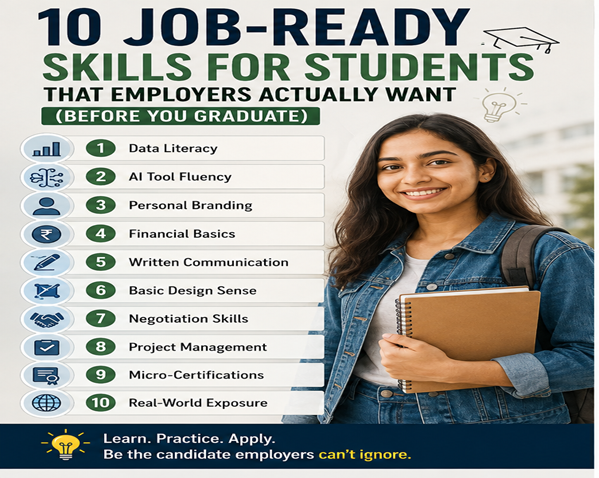
Here’s a list of some of the most important job-ready skills for students apart from their degree.
1. Data Literacy
Now, you may not have to become a data scientist, but at least you must be able to read a spreadsheet without freaking out. Students from arts, commerce, and even humanities backgrounds are increasingly required to spot basic trends or create a simple dashboard using Excel and Google sheets. This is one of the most underrated job-ready skills for students that will teach them to handle data.
- Learn basic Excel formulas, pivot tables, and simple charts
- Try free tools like Google Data Studio for visualizing numbers
- Practice with real datasets from Kaggle instead of textbook examples
This single habit alone can make a huge difference when you’re building your list of job-ready skills for students.
2. Prompt Engineering and AI Tool Fluency
It is new, and it’s non-negotiable.Knowing how to use AI technology effectively will soon become one of the most sought-after skills for students. This includes writing good prompts, verifying data, and using AI to save time when researching or writing drafts. Companies don’t expect you to create AI models, but rather to use them intelligently.
- Practice writing precise, multi-layered prompts instead of general ones
- Know how to verify information that comes from AI
- Use AI to stimulate creativity, not replace your thoughts
3. Personal Branding on Professional Platforms
In many cases, your LinkedIn profile is the first “interview” a recruiter conducts. Yet, very few students give much thought to their LinkedIn profiles.Building a basic personal brand by sharing what you’ve learned, showcasing your projects, and offering short reflections can help you stand out. It shows recruiters that you take initiative even before the interview.
- Consistently post content related to certifications and small projects
- Have a specific, clear headline rather than just being “Student at XYZ College”
- Like and engage with posts in your industry
4. Financial Basics
This is never taught in school, but it could be one of the most useful things that one could know before graduating. Basic knowledge of budgeting, taxes, and investments can help you stand out in job interviews. Knowing how to read a company’s P&L statement can also be useful for roles in operations, sales, or management trainee programs.
- Begin by making a monthly budget for yourself
- Know about mutual funds, SIPs, and tax-saving tools
- Read one piece of business news every day to understand the market trends
5. Written Communication
Emails, reports, and proposals – most entry-level jobs revolve around the ability to write. However, there is a difference between “correct” writing and writing that actually communicates. Recruiters appreciate candidates who can explain complex ideas in three clear lines. This is better than using ten confusing lines to explain the same thing.
- Learn how to rewrite lengthy paragraphs into concise summaries
- Try reading your emails aloud before you send them
- Learn how to write a follow-up email
6. Basic Design Sense
You don’t have to be a graphic designer, but knowing how to make a clean presentation, a readable resume, or a simple social media post gives you a real edge. This is one of those quiet job-ready skills for students that separates an average intern from a memorable one.
- Learn the basics of Canva for quick, professional-looking designs
- Understand simple layout principles: spacing, alignment, contrast
- Study company presentation decks to see what “clean” actually looks like
7. Negotiation and Self-Advocacy
When negotiating your internship stipend or receiving feedback on your first review, you may find that many students simply freeze. They often struggle to know what to say or how to respond. It becomes an essential ability to be able to assert yourself politely.
- Small negotiation exercises, such as negotiating deadlines on projects with teachers
- Prepare your talking points for your salary
- Practice asking “why” to feedback received rather than just accepting it
8. Project Management on a Small Scale
A PMP credential is not required to prove one’s project management skills. Planning and executing a college fest, scheduling a timeline for a team assignment, and managing a small college event all qualify. The main thing is proving that you can plan and deliver on time.
- Make use of free tools like Trello or Notion for task and deadline tracking
- Mention what you have managed in your CV
- Work on dividing large tasks into smaller milestones
9. Industry-Specific Micro-Certifications
A generic certificate does not really make any impact these days; however, an industry-specific one will.A short course in digital marketing analytics, basic SQL, or content strategy can be directly relevant to your desired industry. It shows that you are building skills with a clear career goal rather than collecting random certificates.
- Select certifications that align with your career objective and not popular trends
- Select courses that have practical elements over video-based courses
- Include the particular skill set along with the name of the certification in your resume
10. Adaptability Through Real-World Exposure
This one is not a “skill”, but it’s definitely the most crucial among all the top 10 skills that students should develop in college. Internships, freelancing, part-time jobs, and volunteering can give you valuable real-world experience. They teach you how to handle uncertainty, deadlines, and feedback in ways that a classroom cannot.
- Get an internship or freelance project done at least once before the last year in college
- Agree to do something slightly out of your comfort zone in the internship
- Think about what you have learned in each experience
The Bottom Line
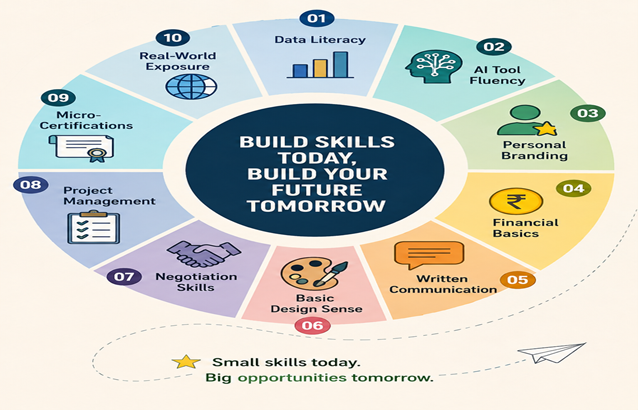
Nobody becomes job-ready overnight, and that’s honestly the point. These are skills to learn before graduation because they take time to build naturally. You develop them through small, consistent efforts rather than a last-minute rush.
Building even a handful of solid job-ready skills for students now can save you months of struggle later. Pick two or three skills from this list and get genuinely good at them. Walk into your first job interview with something most of your peers may not have: proof, not just promises.