
Real personality development activities for students that build confidence, communication, and soft skills.
I still remember the first time I took a personality development workshop, which was happening in my college. In a group of forty students, only five could volunteer by themselves. The remaining thirty-five would keep their eyes locked onto their notebooks, afraid that somebody would call on them. After eight weeks, almost everyone wanted to volunteer to go first. No magic trick was involved. They just did what they were supposed to do in their personality development activities.
That’s why I wanted to write about this. The majority of personality development activities tips we found on the internet usually come straight out of a corporate training handbook. But what really works for college students is a bit more complex and much more personal. It revolves around their fears of going through the interview process, group discussions, peer pressure, and other challenges.
Why Personality Development Matters for Students
Marks make a student eligible, but personality helps to get them hired and remembered. Recruiters, teachers, and even family members tend to evaluate a student’s personality during their first interaction with them. This is the reason why the concept of personality development of students has gained so much significance in colleges during recent years and has not been just about any extra-curricular activity anymore. Good personality development training, built on the right activities, closes that gap between knowledge and expression.
The proper personality development activities do not involve trying to change the student’s identity. The whole philosophy behind all these activities lies in getting rid of the friction that exists between their knowledge and confidence to express it.
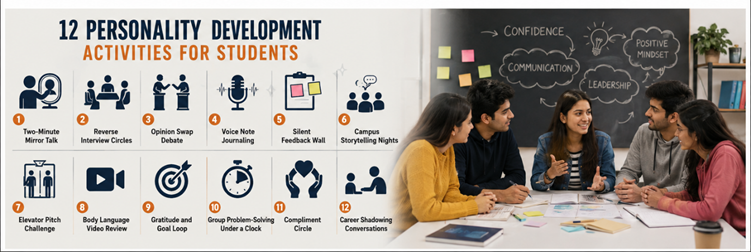
12 Personality Development Activities for Students That Go Beyond the Usual List
Here are the personality development activities that consistently worked in real classrooms, not just on paper.
1. The Two-Minute Mirror Talk
Every student should practice talking in front of a mirror every day. You can talk about any topic or anything that comes to your mind. Do not take any pause and try not to use any scripts. It is an exercise will help students to improve speaking skills much more effectively in just three weeks than many regular classroom lectures would.
2. Reverse Interview Circles
In a traditional mock interview, the instructor interviews the student. Instead, let the student take the interviewer’s role and interview another student. This way, you learn to look at the situation from the recruiter’s point of view, thus you will develop the skills required when being interviewed.
3. The Opinion Swap Debate
Assign students a position they personally disagree with and make them argue for it in a short debate. This is one of the most underrated soft skills activities for college students because it builds empathy, flexible thinking, and the ability to argue logically even under pressure. This skill pays off in group discussions and case study rounds.
4. Voice Note Journaling
Rather than keeping a diary, students can record a two-minute voice note each night, detailing one thing that went well and one thing they’d do differently. Often the biggest confidence trigger is listening back to their own recordings after a month because they can actually hear how much clearer and calmer they sound.
5. The Silent Feedback Wall
Create a blank chart in the classroom or hostel common room for classmates to put down anonymously, on a weekly basis, one strength and one area of growth for each other. Peer feedback, particularly anonymous and low-pressure, can be more effective than a trainer’s comments, and it creates a habit of both giving and receiving criticism with grace.
6. Campus Storytelling Nights
Once a month get a small group together and have each student tell a real personal story in under three minutes, no notes. This brings public speaking, emotional expression and audience engagement together in one exercise. This is always the activity that students enjoyed the most.
7. The Elevator Pitch Challenge
Give students 30 seconds to introduce themselves as if they are meeting an HR manager in a lift. The time limit helps them speak clearly and avoid long, rehearsed introductions. This exercise will help students stand out during their interview.
8. Body Language Video Review
Record students during a short presentation and watch it back together, pointing out posture, hand movement, that they aren’t aware of. Seeing themselves on screen is uncomfortable the first time, but it’s one of the fastest ways to correct nonverbal habits.
9. The Gratitude and Goal Loop
Start each session by having students share one thing they’re grateful for and one small goal for the week. It sounds simple, but this activity for college students builds a positive mindset and self-accountability without feeling like a lecture on positivity.
10. Group Problem-Solving Under a Clock
Give a team a real-world problem planning a fest with a shoestring budget, for instance, and a strict fifteen-minute deadline. Time pressure reveals leadership styles, communication gaps, and decision-making patterns faster than any personality test.
11. The Compliment Circle
At the end of a group activity, each student has to give one genuine, specific compliment to another member. This isn’t as soft as it sounds; it trains students to observe others closely and articulate praise clearly, which is a surprisingly rare skill.
12. Career Shadowing Conversations
Encourage students to have a conversation with someone working in their dream field, in person or online, and then present three key takeaways to the class. This connects personality development directly to career clarity, something most generic activities lack.
How Colleges Can Build Personality Development Activities Into Regular Life
- Dedicate fifteen minutes at the start of any club meeting or tutorial to one quick activity from this list
- Rotate responsibility for leading warm-up activities among students instead of always relying on a trainer
- Track progress informally through peer feedback rather than formal grading, so students don’t feel evaluated
- Mix serious activities like debates with lighter ones like storytelling nights to avoid burnout
- Involve final-year students as informal mentors for juniors during these sessions
Conclusion
Personality development activities aren’t a one-week bootcamp before placement season. It’s a habit built through small and slightly uncomfortable activities that push students to speak and connect. Start with two or three exercises from this list, stay consistent for a month, and the shift in confidence will be visible.