
Planning a career in public policy in India? Explore top courses, job roles, who can apply and a simple 12-month plan to start your journey today.
Introduction
Ever read about a new law and wondered who wrote it? Someone studied the problem. Someone weighed the options. Someone drafted the brief. That someone is often a policy professional. A career in public policy in India lets you do that work. It is not just for civil servants anymore. Think tanks, startups, NGOs, and big companies even employ policy experts. This guide will touch on education, job opportunities, and an easy way to get started. Let’s get going!

Why a Career in Public Policy in India Is Growing Fast
India is undergoing rapid transformation. Issues related to digital payments, climate change goals, health schemes, and artificial intelligence policies require proper framing. Somebody needs to ask pertinent questions before implementing any policy. Is it feasible? Who will benefit from the policy? Who will be deprived of it? Policy professionals provide answers through evidence-based writing.
Earlier, most openings sat inside government. That has shifted. Today, a career in public policy can sit inside a bank, a software firm or a charity. The work is varied. The impact is real. And the field still has room for new voices.
What Do Policy Professionals Do All Day?
Think of a career in public policy as three verbs: study, shape and speak. Study the problem. Shape the solution. Speak up for it. In practice, that looks like this:
- Read reports and identify missing information
- Work on surveys or governmental data cleaning and reading
- Write short papers for busy people
- Meet with authorities, specialists and local people
- Assess how well a project fulfilled its goals
Each week brings something new. During one month, you will be working on school dropouts’ statistics, and during another – you will assist an organization in complying with some data regulation.
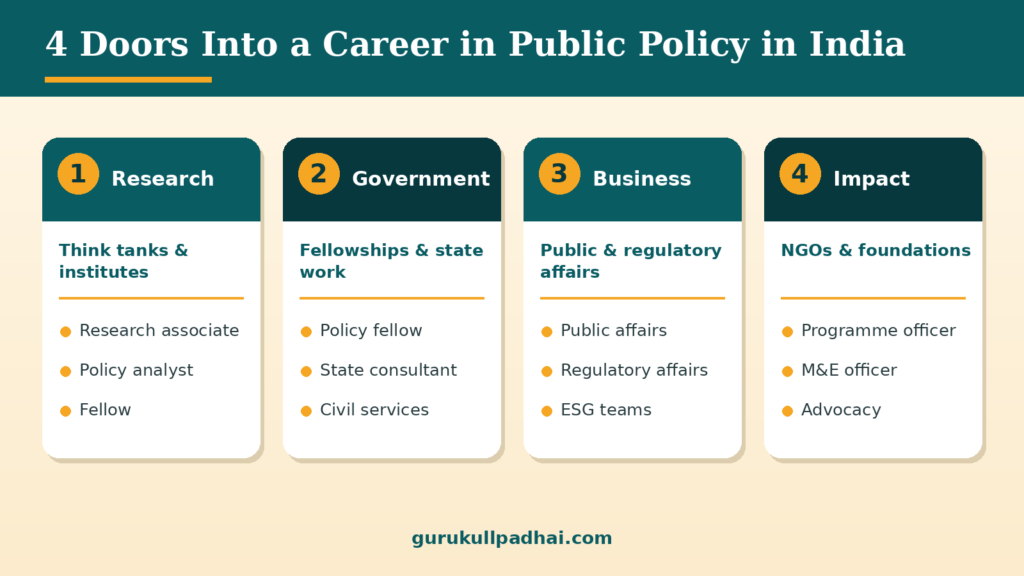
Public Policy Jobs in India: Four Doors You Can Enter
Most people see only one path. There are really four. Pick the one that matches how you like to work.
- The Research Door: Think Tanks and research institutes. The positions held can include research associates, fellows and policy analysts.
- The Government Door: Fellowships, advisory work with the state department and civil service.
- The Business Door: Public Affairs, Regulatory Affairs and ESG teams at corporations required to comply with regulations.
- The Impact Door: Non-governmental organisations, foundations and development agencies. Consider programme associate and M&E positions.
Here is a tip most guides skip. Entry titles rarely say “policy”. Search for “research associate”, “analyst”, “fellow” and “programme associate” too. A career in public policy in India often starts with a title that sounds quite ordinary.
Public Policy Career Opportunities: Where Demand Is Rising
Some topics are heating up. Keep an eye on these:
- AI and data rules
- Climate and clean energy
- Public health
- Digital public services
- Urban housing and transport
Pick one topic you truly care about. Then go deep. In policy hiring, depth beats breadth. Over time, an analyst can grow into a senior researcher, programme lead or policy advisor. That is why a career in public policy grows with you.
Public Policy Courses After Graduation: Three Routes
Public policy courses in India fall into three formats. Choose by time, money and where you are in life.
1. Full-time two-year master’s. Most suitable for freshers. IIT Tirupati is accepting applications for its MPP course of study for 2026-28 in two streams. One requires a GATE score. The other doesn’t require one. HSNC University of Mumbai is offering two-year MPP and one-year diploma course starting from 2026-27. DY Patil’s MPP course comprises 80 credits with policy lab and internship. Its tuition for 2026-27 is ₹5.6 lakh per annum.
2. One-year programmes. Useful if speed is of essence. O.P. Jindal Global University launches a one-year master’s course in Public Policy from Fall 2026. The only eligibility criteria are to have completed a bachelor’s degree from a UGC-accredited institution. There are no minimum experience or age eligibility requirements.
3. Executive and blended programmes. Built for working people. IIM Bangalore’s PGPPM runs 14 months in a hybrid format. Its fee was about ₹20 lakh for the 2025 batch.
Fees and dates change every year. Always confirm them on the official page. Whichever route you pick, a career in public policy rewards people who can show real work.
Public Policy Degree in India: What to Check Before You Apply
Do not pick a course by brand alone. Use this checklist:
- Does the syllabus include economics, statistics and writing?
- Is there a field project, policy lab or internship?
- Do the teachers have real policy experience?
- Where did the last batch find jobs?
- Does the fee match the pay in your target roles?
Ask the admissions team for these answers in writing. Choose the course that fits your goals, not just the one with the loudest name.
Who Can Build a Career in Public Policy in India?
Almost anyone. You do not need a policy background to start. Your own degree is a head start.
- Students of journalism and media: This is your strength – research, simplification, and writing for the audience. It is something that policy communication and advocacy require desperately.
- Students of engineering: Technology policy, data governance, and cybersecurity require people who understand systems.
- Students of law: Compliance and regulatory roles require your approach to interpreting regulations.
- Students of economics and commerce: Your skills match budgeting, public finance, and impact studies.
Whatever you studied, there is a place for you.
How to Become a Public Policy Professional: A 12-Month Plan
Here is a plan you can start this week.
- Months 1-2: Choose one topic. Topics such as water, school-based learning or city transportation can work. Read the background material.
- Months 3-4: Learn about spreadsheets and basic graphs. Take any free course available.
- Months 5-6: Prepare a two page memorandum on a local issue. Publish it online.
- Months 7-9: Apply to internships and fellowships at think-tanks and NGOs.
- Months 10-12: Based on your learning, select a master’s program or job opportunity.
Your brief is your proof. Hiring managers trust proof more than promises. That is how a policy career really begins.
Three Myths About a Career in Public Policy in India
- Myth: You must clear the civil services. Not true. Many paths sit outside government.
- Myth: You need a foreign degree. Not true. Several Indian programmes now offer strong training.
- Myth: It is all theory. Not true. Good programmes include labs, field work and internships.
Conclusion
Public policy is about solving real problems with evidence. Start with one issue. Write one brief. Choose a course that fits your budget and goals. A career in public policy in India is open to curious people from every background. Take the first step this month.