
Learn how to build a job-ready portfolio for students before graduation. Practical steps, real project ideas and tips to impress recruiters on day one.
Introduction
Here is a hard truth. A degree opens the door. A portfolio walks you inside.
Recruiters read hundreds of similar resumes. Same degree. Same marks. Same skills list. So what sets you apart? Proof. That is why a job-ready portfolio for students matters so much today. It shows what you can do, not just what you studied. The good news? You can start now, even in your first year. Let’s make it simple.
Why a Student Portfolio Beats a Plain Resume
The resume makes promises; the student’s portfolio verifies them. Consider the culinary analogy: The resume will list the ingredients needed for preparing the dish, whereas the portfolio provides the recipe.
These are some things that the portfolio will demonstrate but that a resume cannot:
- How you process your thoughts on a problem
- How you work using the real thing
- How you get things done
- How you communicate your ideas
Employers love this because it saves time. They can judge your skills in two minutes, not twenty. A job-ready portfolio for students makes that decision easy.
How to Build a Student Portfolio: Start With a Skill Audit
Students typically start by creating their website. This is the wrong place to begin. The first step should always be an audit. Get yourself a piece of paper and make three columns:
- Skills I possess
- Skills required by employers in my field of work
- The skills gap
Then check out ten job ads for entry-level positions. Highlight the skills that appear again and again. This is what you need to learn in order to get hired. This could be Excel, writing, programming, or client management. Your skills gap is your road map. Each thing that you create must fill one gap.
Five Projects to Include in Your Job-Ready Portfolio for Students
You do not need fancy work. You need relevant work. Pick from this list:
- A real-world project. Solve a small problem for a local shop, an NGO, or your college club.
- A mini case study. Pick a brand. Study one problem. Suggest a fix.
- A group project, explained. Say what you did, not what the team did.
- An internship or freelance sample. Even one small gig counts.
- A self-started project. Build an app, a blog, a podcast, or a research note.
A portfolio for college students works best when it has variety. Mix two or three types. Do not dump every assignment you ever submitted.
Write Every Project as a Mini Story
Your job-ready portfolio for students should tell stories, not just show files. Use this simple formula for each project:
- Problem: What was the issue?
- Action: What did you do?
- Tools: What did you use?
- Result: What changed because of you?
Use numbers whenever you can. For example, “Increased Instagram following by 40%” looks better than “Managed social media.” But don’t exaggerate because your interviewers will ask follow-up questions.
Limit your stories to 150 words. Also add an image or a link. That’s all you need. A tight college student portfolio always trumps a bulky one.
Where to Host Your Job-Ready Portfolio for Students
Where you host matters less than how easy it is to open. Choose one home:
- Free website: Google Sites, Wix, or WordPress
- PDF portfolio: Great for design, media, and writing
- GitHub: Best for coding projects
- Notion or Behance page: Neat and quick to set up
Add a short bio, your email, and your LinkedIn link. Keep the design clean. Test the link on your phone. Many recruiters open it there first.
Show Job-Ready Skills for Students Beyond Technical Work
Companies hire people, not just skills. So show the human side too. Remember, a job-ready portfolio for students is part skill and part character.
Add these:
- A short note on teamwork from a group project
- A leadership role in a club or fest
- A line on how you handled a tight deadline
- A testimonial from a mentor or teammate
Even one line of feedback builds trust. Ask a professor for two lines. It takes five minutes.
A Simple 6-Month Plan to Get Started
No time? Use this plan.
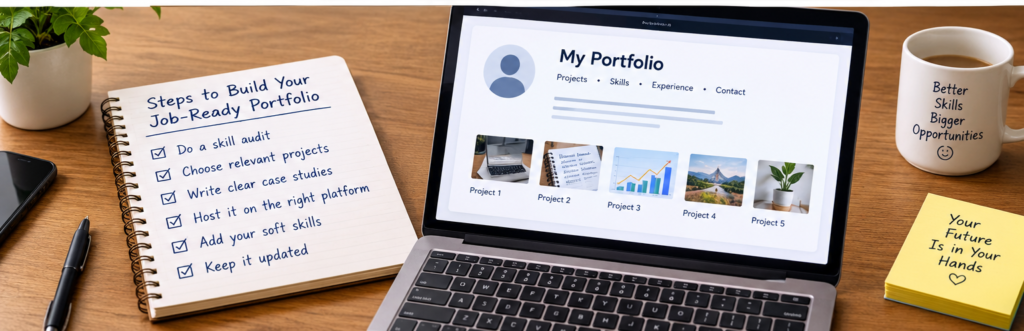
- Month 1: Do the skill audit. Pick your platform.
- Month 2: Finish one strong project.
- Month 3: Write the case study. Add visuals.
- Month 4: Take a small freelance or volunteer task.
- Month 5: Collect feedback. Fix weak spots.
- Month 6: Share it. Add the link to your resume and LinkedIn.
Small steps beat big plans. One hour a day can build a job-ready portfolio for students within a single semester.
Avoid These Common Mistakes
Watch out for these traps:
- Adding too many weak projects
- Copying a template without any personal touch
- Forgetting to update it
- Using vague words like “hardworking”
- Hiding the link at the bottom of your resume
Quality beats quantity. Five sharp pieces are better than twenty average ones.
Try the 60-Second Recruiter Test
Here is a trick most blogs skip. Ask a friend to open your portfolio for just 60 seconds. Then ask three questions:
- What do I do?
- What is my best work?
- Would you shortlist me?
If they hesitate, simplify. A good college student portfolio makes the answers obvious fast. Repeat the test every few months with a new person. A job-ready portfolio for students should pass it easily.
Your Quick Pre-Launch Checklist
Before you share the link, tick these off:
- A one-line headline that says who you are
- Three to five strong projects
- Clear results or learnings for each
- Contact details that work
- Zero spelling mistakes
A polished job-ready portfolio for students does not need to be perfect. It needs to be clear, honest, and live.
Conclusion
Your degree means you have studied, but your portfolio means that you can actually do things. Think big, choose projects that will help you achieve your career objectives, and improve on them. Include all your best work, skills, and accomplishments as you gain experience. Building a job-ready portfolio for students takes time, but starting today can make your career journey stronger.