
Introduction
So, you want to fly planes for a living. Good choice.
But let’s be honest. Most guides on how to become a pilot in India throw a wall of DGCA jargon at you and call it a day. That’s not what you need.
You require a roadmap, which will give you the order of things, the costs involved, and those aspects which people never mention till you spend hundreds of thousands. This is precisely what we shall provide you in this blog. Let us get started.
Who Can Even Apply?
Before you dream about cockpits, check if you qualify. It’s a quick checklist.
- Age: 16 for a Student Pilot Licence, 17 for a Private Pilot Licence, and 18 for a Commercial Pilot Licence (CPL)
- Education: Class 12 with Physics and Maths is the standard route
- Not from Science? Don’t panic. A NIOS bridge course now lets Commerce and Arts students cover the PCM gap. It takes 3-6 months and costs roughly ₹15,000-₹40,000
- English proficiency: You’ll need ICAO Level 4 English, spoken and understood clearly
- Medical fitness: Non-negotiable. More on this below
However, one important piece of information that is generally not covered by most write-ups is that the DGCA has already approved the scrapping of the compulsory Physics-Maths condition. This awaits clearance from the Ministry of Civil Aviation. If implemented by 2026, the list of eligibility criteria above will become even smaller for those who are not in the science stream.
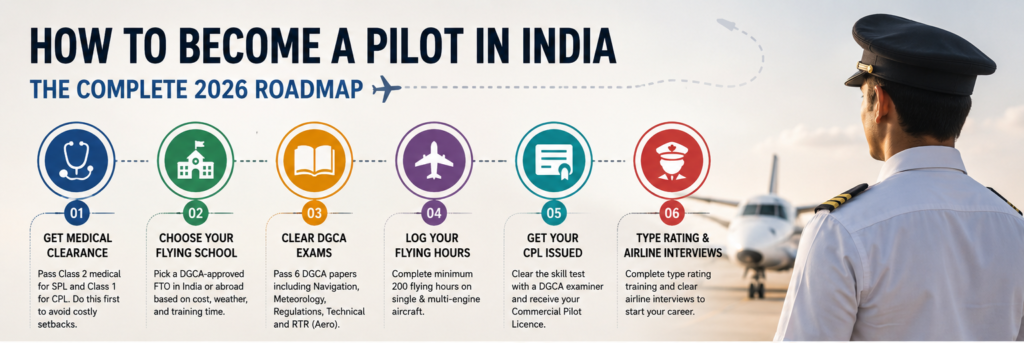
Step 1: Get Your Medical Clearance First
This is the step people skip, and it costs them the most.
Every guide on how to become a pilot in India buries the medical check somewhere in the middle. We’re putting it first, because that’s the order that actually saves you money.
- Class 2 Medical: This gets you a Student Pilot Licence. It checks vision (6/6 with or without glasses), hearing, and general fitness. Valid for 2 years if you’re under 40
- Class 1 Medical: The stricter one. You need this to hold a CPL. It covers detailed heart, eye, and neurological checks
Roughly 1 in 10 aspiring pilots discover a disqualifying issue at this stage. Get medically cleared before you enrol anywhere. Not after.
Step 2: Choose Your Flying School Wisely
Only DGCA-approved Flying Training Organisations (FTOs) count. There are close to 35-40 of them across India right now.
Here’s the real decision point people struggle with:
- Train in India: Cheaper overall, but weather delays (monsoon season especially) can stretch your timeline
- Train abroad: The USA, South Africa, and New Zealand are popular for better flying weather and faster aircraft slots. But you’ll need to clear conversion exams when you return
Pick based on your budget and your patience for delays, not just brand names.
Step 3: Clear Ground School and DGCA Exams
This is the part that actually eliminates most candidates. Not the flying. The exams.
You’ll study and clear six DGCA papers:
- Air Navigation
- Meteorology
- Air Regulations
- Technical General
- Technical Specific
- RTR (Aero) — the radio telephony exam
Most students start with Air Regulations and Meteorology since ground school covers those topics early. Pace yourself. These exams test understanding, not memorisation, so cramming rarely works here.
Step 4: Log Your Flying Hours
Time to actually fly.
- You need a minimum of 200 flying hours (some routes require up to 250)
- Training starts on single-engine aircraft like the Cessna 172 or Diamond DA-40
- You’ll progress to multi-engine aircraft as you near your CPL
This stage usually takes 12-14 months if things go smoothly. Weather and aircraft availability are the two things that stretch it further, so build in buffer time when you plan how to become a pilot in India on your own timeline.
Step 5: Get Your CPL Issued
After completing your hours and examinations, you take your skill test conducted by a DGCA examiner. Once you have passed this, your CPL is issued. By now, you are officially licensed to fly commercially but you are not airline-ready yet.
Step 6: Type Rating and Airline Interviews
This is the last mile, and it’s the part most guides gloss over.
- Type Rating: Specific training for an aircraft like the Airbus A320 or Boeing 737. This alone can cost ₹15-20 lakhs
- Airline interviews: Airlines like IndiGo, Air India, and Akasa run cadet and direct-entry interviews. A strong interview matters as much as your logbook
Some flying schools bundle a cadet programme with a guaranteed airline placement. It costs more upfront, but it removes the job-hunting uncertainty later.
What Does It Actually Cost?
Let’s talk real numbers, because this is where most students get blindsided.
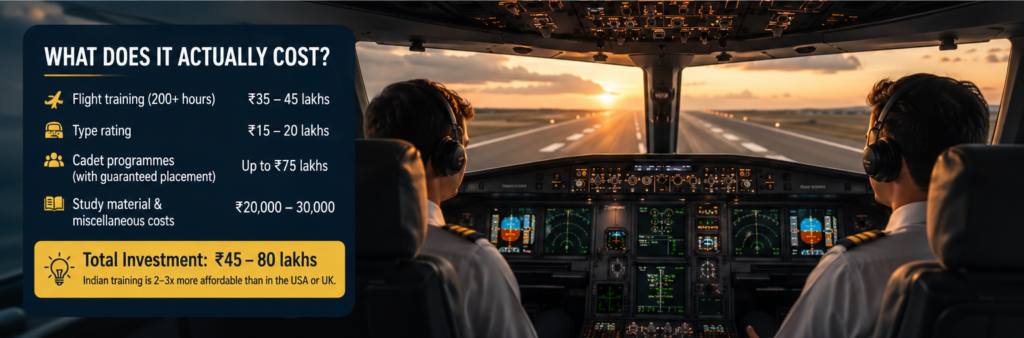
- Flight training (200+ hours): ₹35-45 lakhs
- Type rating: ₹15-20 lakhs extra
- Cadet programmes with guaranteed placement: Can go up to ₹75 lakhs
- Study material and miscellaneous costs: ₹20,000-30,000
Basically, you should be prepared to spend anything from ₹45 lakh to ₹80 lakh, depending on the school and path you choose. But when you compare this with foreign training, Indian education is still more affordable; it is two to three times more expensive in the USA or the UK.
Realistic Timeline: How Long Does It Take?
Anyone searching how to become a pilot in India wants one honest answer: how long will this actually take?
Here’s a realistic breakdown:
- Months 1-3: Class 2 medical, computer number registration on eGCA
- Months 4-9: Ground school and DGCA written exams
- Months 10-22: Flight training and hour-building
- Months 23-26: CPL issuance and airline interview prep
- Month 27 onward: Type rating and joining an airline
Total: roughly 2 to 3 years for most students who don’t hit major setbacks.
Is There a Free or Low-Cost Route?
Yes, but it is not often talked about.
The Indian Air Force and Indian Navy provide pilot training to candidates at no cost to them via NDA and CDS entry modes. It is a more stringent selection procedure, but it is the only real way of getting into flying without paying anything. This may be worth looking into if the ₹50 lakh entry fee seems too expensive.
Final Thoughts
Becoming a pilot in India isn’t complicated. It’s just long, and it rewards planning over enthusiasm. If you want to know how to become a pilot, then make sure to get yourself medically cleared first. Plan your budget realistically, select an approved institution from the DGCA, and allow buffer time for weather conditions or even exams. Do all this, and the cockpit is no longer a dream but a reality.