
Still believing law school myths? Here’s the real truth about studying law, career options, and what actually matters.

Each year, thousands of Class 12 students take seats opposite their parents around the dining table and come up with the same old suggestion: “I think I want to do law.” Each year, there’s always somebody who comes up with the same old cliches: “You will be arguing all day.” “You have to remember the whole constitution.” “Only toppers go to good colleges.” “Law is a boring profession unless you become a judge or a top lawyer.”
None of that is entirely true. Some of it isn’t true at all.
This blog is directed at those who have been searching “is law a good career” on Google. Here we will go through the most frequent law school myths, the reasons why they emerge, and the truth.
WHY DO THESE LAW SCHOOL MYTHS EVEN EXIST?
Here’s a simpler and more natural version:
Most people form their ideas about law school from courtroom movies, advice from relatives who “know a lawyer,” or stories shared by seniors. Since schools rarely explain what studying law is really like, many assumptions spread, and over time, people start believing them as facts.
Let’s fix that, one myth at a time.
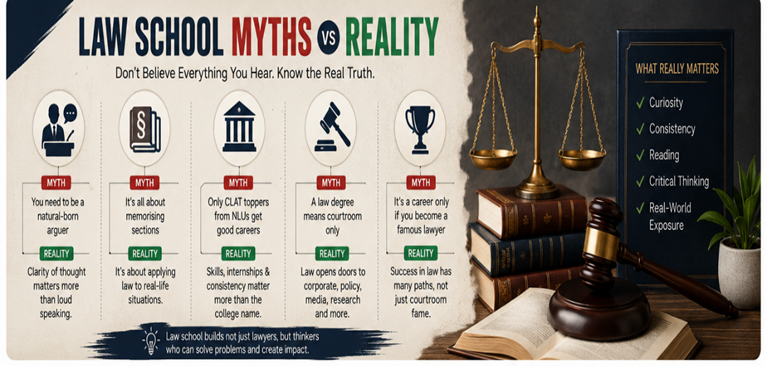
MYTH 1: YOU NEED TO BE A NATURAL-BORN ARGUER
It may be one of the largest law school myths. One tends to think that studying law is like a five-year debate match where those who speak louder tend to win.
The fact of the matter is that law favors a person’s clarity of mind rather than how loudly he or she speaks. The best lawyers do not make the loudest voices possible in class but are those who can read, think logically, and understand when it is best to just listen. Though litigation requires good oral skills, it is only one of the many areas of law.
MYTH 2: LAW SCHOOL IS JUST MEMORISING SECTIONS AND ACTS
Yes, you will be studying many legal statutes. No, memorization of the statute is not the objective. The objective is being able to apply the provision to a new, complicated set of facts on law exams and internships. Knowledge of the reasoning process of the statute carries more weight than knowledge of its numbering. Most professors frown upon the idea of blind memorization since it falls apart as soon as the question is varied in any way.
MYTH 3: ONLY CLAT TOPPERS FROM NLUs GET GOOD CAREERS
CLAT and the NLUs receive great deal of importance, but this does not mean that they are the only way to pursue a successful legal career.
- Some of the successful lawyers, judges, and legal consultants come from state law universities, private law colleges, and even distance LLB programs.
- More and more recruiters give greater importance to internships, writing samples, and performances in moot court than to the college logo on your degree.
- The exam for judicial services, in particular, doesn’t care where you studied law.
A CLAT rank can open doors faster, but it is not the only door in the building.
MYTH 4: A LAW DEGREE MEANS YOU’LL END UP IN A COURTROOM
One of the key concepts to remember before studying law is that courtroom litigation is just one of many paths available through a law degree.
Today’s law graduates include those who have become:
- In-house lawyers in companies dealing with contracts and compliance;
- Legal researchers and policy analysts in think tanks and government organizations;
- Legal reporters and content creators providing information about the law to the general public;
- Compliance officers in banks, fintech and insurance;
- Legal process experts in LPOs and legal tech startups;
- Academics and professors of law.
Not interested in courtroom drama? No problem! This is just one of many exits on a pretty long road.
MYTH 5: IS LAW A GOOD CAREER ONLY IF YOU BECOME A FAMOUS LAWYER
In some way or the other, being a “successful lawyer” became synonymous with being a “famous senior advocate appearing before the Supreme Court.” This is quite unjust and, more importantly, unrealistic.
Is law a good career? Yes, for most students, but then it depends on what success means for each one individually. Being a corporate lawyer, a government sector lawyer, a compliance expert, or even a specialist in intellectual property and cyber law may be a “good career” for many students. Fame in the profession is definitely an exception.
MYTH 6: LAW IS A “BACKUP” DEGREE FOR THOSE WHO DIDN’T GET INTO ENGINEERING OR MEDICINE
This law school myth has been quietly working towards undermining the seriousness with which people approach law as a first choice. The truth is that law today is an attractive field of study for very competent and competitive applicants, especially because of the recent development of the five-year integrated courses that start immediately after Class 12.
MYTH 7: YOU MUST BE FLUENT IN ENGLISH TO SURVIVE LAW SCHOOL
Though English is dominant in legal education and the majority of the higher courts, yet it is not a barrier which cannot be overcome. The fact is that many students do gain proficiency in legal English quite quickly in their first year through moots, debates, and continuous reading. Proficiency in regional languages is also an advantage for district court work, where much of India’s litigation takes place.
THE PART NOBODY TELLS YOU: THE REAL SKILL LAW SCHOOL BUILDS
Here’s something you won’t find repeated across most law school myths articles: the single most valuable thing law school builds isn’t legal knowledge. Laws change constantly, sections get amended, judgments get overruled. What stays with you is a specific way of thinking: breaking a messy problem into smaller questions, checking both sides of an argument before picking one, and writing so that someone with zero context can follow your logic in one read.
That skill transfers into policy work, business strategy, journalism, entrepreneurship, and civil services just as easily as it transfers into a courtroom. It’s arguably the most underrated reason law remains a genuinely good career choice, and it’s rarely the reason anyone chooses it in the first place.
THINGS TO KNOW BEFORE STUDYING LAW: A QUICK CHECKLIST
- Reading load is heavy and constant, not occasional
- Internships from the first year onward matter as much as grades
- Moot courts build practical skills that textbooks can’t
- Networking and mentorship shape opportunities more than most students expect
- Specialisation (corporate, criminal, IP, tax, human rights) usually happens after the basics, not before
- Early income in litigation can be modest; corporate and compliance roles often pay better sooner
CONCLUSION
Law school myths persist because law, as a career, is far more varied than the courtroom scenes we grow up watching. Studying law doesn’t demand a golden tongue, a photographic memory, or a seat in a top-five college. It demands curiosity, consistency, and a willingness to read a lot. Whether you end up arguing a case, drafting a contract, or writing about the law itself, the degree opens more doors than the myths ever let on.