
Explore the top 10 universities in the world in 2026 based on QS Rankings. Compare global universities, courses, and choose the best fit for your future.
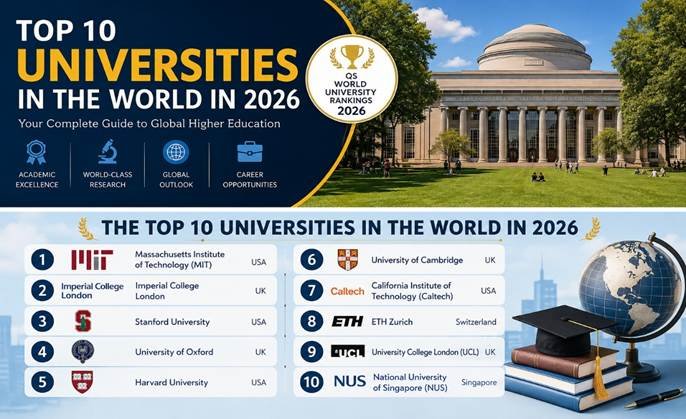
Every single year, thousands upon thousands of students, their parents and even career counsellors look up to the ranking lists of universities from all over the world in order to learn which institutions provide the best education possible. To be fair, it seems logical enough – when you are going to spend several years and quite a bit of money to earn your degree, you want to be sure that this institution can guarantee you its reputation, resources and opportunities.
So let’s get down to brass tacks and see which universities made it into the top 10 list based on the latest QS World University Rankings.
Why Rankings Like QS Actually Matter
Before we get to the list, it is important to understand how this ranking is done. The QS World University Rankings rank these institutions based on aspects such as reputation among academics and employers, faculty-student ratio, research citations, international outlook, and graduate employability. This means that this ranking does not just rely on prestige. Instead, it looks at how reputable an institution is regarded by these entities all over the world.
Based on this background information, let us look at the top 10 universities in the world for this year.
The Top 10 Universities in the World
1. Massachusetts Institute of Technology (MIT), USA
MIT is the clear winner in the league table having consistently occupied the number one position for more than a decade now. Its strengths lie in the disciplines of engineering and computer science and the research environment which encourages creativity among students. If STEM is what excites you, MIT is still the cream of the crop.
2. Imperial College London, UK
Imperial has already become known as one of the best ten universities globally, especially with regard to science, engineering, medicine, and business. The university’s placement in London provides students an additional advantage since London is one of the largest centers where research financing takes place.
3. Stanford University, USA
The nearness of Stanford University to Silicon Valley makes it an obvious choice for the technologically inclined students. The university enjoys a close association with tech giants, which means that students get into high-profile jobs after graduating.
4. University of Oxford, UK
One of the oldest universities in the world, Oxford blends centuries of academic tradition with cutting-edge research. It consistently scores near perfect marks in academic reputation and international research collaboration.
5. Harvard University, USA
Harvard’s name alone carries enormous weight, but it is the institution’s depth across law, business, medicine, and the humanities that keeps it firmly among the top 10 universities in the world year after year.
6. University of Cambridge, UK
Cambridge rounds out the UK’s strong presence on this list. Known for rigorous academics and a tutorial-based teaching style, it remains a top choice for students pursuing research-heavy disciplines.
7. California Institute of Technology (Caltech), USA
Caltech may be smaller than the other institutions on this list, but its research output per student is extraordinary. It is a serious contender for anyone focused purely on science and engineering excellence.
8. ETH Zurich, Switzerland
ETH Zurich is the top continental European university in the list and is famous for its programs in engineering, natural sciences, and mathematics. It is also more affordable than most universities in the US and the UK.
9. University College London (UCL), UK
UCL’s broad academic range, from medicine to architecture to social sciences, has helped it climb steadily. It is particularly popular among international students for its diverse, multicultural campus.
10. National University of Singapore (NUS), Singapore
NUS is the best representation from Asia in the top 10 universities in the world due to Singapore’s quick rise as an education center. The university is highly ranked in fields such as business, engineering and computing.

What This List Tells Us About Global Higher Education
A few patterns are worth noticing here:
- The US and the UK retain their dominance at the absolute top level, but this dominance is gradually weakening each year.
- The Asian universities, represented by NUS, are continuously improving their standing and becoming more globally recognized.
- The best performance of the Continental European universities is represented by ETH Zurich of Switzerland.
- The two most important criteria distinguishing these universities are employer reputation and research productivity.
How Should You Use This List?
As a student who is searching for universities to enroll into, you should not take the ranking presented as gospel truth. It all depends on what you want to major in, your financial status, the location where you would like to stay, and the kind of career that you want to pursue after graduation. It may turn out that an 8th ranked university worldwide is actually the weakest university in the field you want to study.
That aside, knowledge of the world’s top 10 universities is definitely an advantage to have. This list helps you understand what global excellence looks like and set realistic expectations for your higher education journey.
A Few Tips If You Are Aiming for One of These Universities
- Begin early. Applications that are competitive, especially in the top 10 schools in the world, can take years of preparation, including standardized testing and extra-curricular activities.
- Consider your specialty and focus on that rather than the overall ranking of the university.
- Since these schools cost a lot of money, it is best to find out about funding and scholarships earlier on.
- Contact the students or alumni from that university if possible.
Common Questions Students Ask About These Rankings
- Do rankings change every year?
Yes, but mostly marginally, only at the very top. Institutions such as MIT, Oxford, and Cambridge have held their top positions for many years. However, universities ranked between 10 and 50 often change as institutions in Asia and the Middle East continue to invest heavily in research, faculty, and innovation.
- Is it worth applying only to top-ranked universities?
No, it need not be. A successful application strategy consists of both ambitious universities and universities that have a good chance of accepting you based on your profile. Even among non-global elite universities, you will find good departments, scholarships, and placements.
- Do employers actually care about these rankings?
Yes, somewhat so, but only for entry-level jobs in sectors such as finance, consulting, and technology. Ultimately, though, it is your abilities, internships, and portfolio that become more important than the standing of the school on any particular list.
Conclusion
The top 10 universities in the world represent the highest standards of global higher education. From MIT’s world-class research to NUS’s rapid growth in Asia, each university offers exceptional learning and career opportunities. However, rankings should be used as a means to an end, rather than as the end itself. Take a look at this list to learn what the standard is internationally, then compare it with your personal preferences and budget.