Discover future-ready skills for students and the skills students need for jobs in 2026. A simple, practical guide to get job-ready before you graduate.
Introduction
Every year, thousands of students graduate with good marks and still struggle to get hired. Why? Because employers no longer ask only what you studied. They ask what you can do. That is where future-ready skills for students make the difference. By 2026, AI systems will perform all the mundane tasks, and employers will seek candidates who can think, learn quickly, and communicate effectively. Fortunately, these are skills which can be developed. All you require is a well-crafted strategy along with consistent effort. There is no need for expensive investments and an elite university; anyone can develop these skills in accordance with this guide.
Why Future-Ready Skills for Students Matter Now
Job requirements are evolving much faster than syllabi. AI tools are already able to take care of mundane tasks such as writing a first draft and cleaning up data. This means that the jobs available when you enter the workforce will be entirely different from the ones your seniors have had.
Employers today need people who are good at:
- Learning fast
- Thinking well
- Conveying their thoughts clearly through speech and writing
The tools will continue to change. But these three will remain relevant. Thus, do not chase every new trend. Focus on creating an evergreen foundation. I have witnessed this happening first-hand.
The Skill Stack: Think in Layers
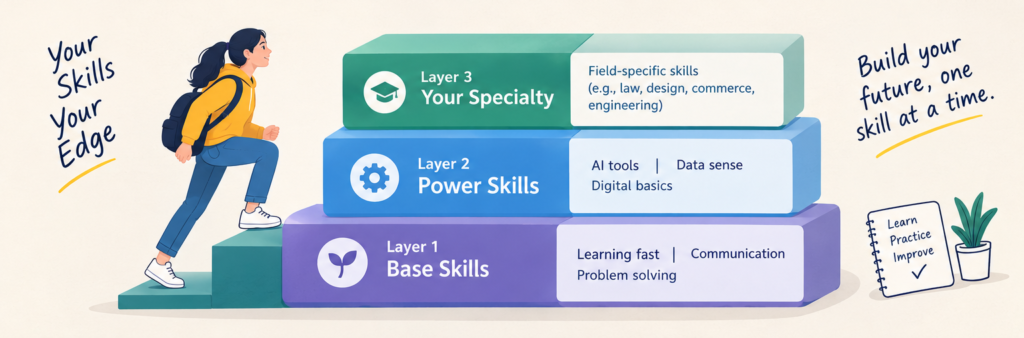
Most blogs give you a long list. That is confusing. Treat future-ready skills for students as a stack instead.
- Layer 1, base skills: learning fast, communication, problem solving.
- Layer 2, power skills: AI tools, data sense, digital basics.
- Layer 3, your specialty: skills from your own field, like law, design, commerce, or engineering.
Build in this order. A strong base makes every other layer easier. Skip it, and the top layers wobble.
Skills Students Need for Jobs in 2026
Here are the skills students need for jobs in 2026. Together they form the core of future-ready skills for students in almost every field.
- AI fluency: ask good questions, then check the answers.
- Data sense: read a chart and spot a wrong number.
- Clear writing: emails, reports, and short updates.
- Digital teamwork: work well on calls and shared files.
- Self-management: meet deadlines without being chased.
Notice something? None of these needs a fancy degree. They need practice. Start with one this month. Small wins build confidence fast.
Skills in Demand in 2026 Most Students Ignore
Everyone talks about coding. Few people talk about the quieter future-ready skills for students that bosses actually notice.
- Checking AI output: catch the error before your manager does.
- Basic automation: save hours on boring, repeated tasks.
- Research habits: find reliable sources fast.
- Taking feedback: hear criticism, then improve quickly.
Why these? They signal maturity, which is hard to fake. The skills that will be sought after in 2026 appear to be modest. But these are the skills that will distinguish ordinary candidates from those that are unforgettable. Choose one this week. Practice it every day.
Job-Ready Skills for Students: Proof Beats Certificates
Here is my rule for building future-ready skills for students: if you cannot show it, it does not count.
Certificates say you attended. Proof says you can do it. Try the proof test for every skill you claim:
- Can I show one real example?
- Can I explain it in two minutes?
- Can I do it without help?
If you answer ‘yes’ to all three questions, you have one of the ‘work ready skills’ that recruiters are looking for. If not, keep on practicing. A single assignment is better than a long list of courses taken. It is easier for recruiters to remember something they can see.
Build Future-Ready Skills for Students in 30 Days
You do not need a year. Thirty focused days can change your profile. Try this plan:
- Week 1: Pick one skill from each layer of your stack.
- Week 2: Spend 30 minutes daily on practice, not just videos.
- Week 3: Make one small project. A report, a sheet, or a short video.
- Week 4: Share it. Ask two people for honest feedback.
Then repeat with the next skill. Small steps add up fast. Consistency beats intensity every time. Even ten focused minutes beat a weekend of cramming.
Common Mistakes Students Make
Many students work hard but aim wrongly. When building future-ready skills for students, avoid these traps. Each one feels harmless. Together they slow you down:
- Collecting courses: ten half-finished courses help nobody.
- Copying trends: a skill that is popular online may not suit your field.
- Ignoring soft skills: teamwork often decides who gets promoted.
- Waiting to feel ready: you never will. Start messy.
Fix one mistake at a time. You will feel the difference quickly. Be kind to yourself while you fix them.
Future Skills for Students: A Quick Self-Check
Time for honesty. Rate yourself from 1 to 5 on these future-ready skills for students. Be honest. Nobody else will see your score:
- I can explain my ideas clearly in writing.
- I can use an AI tool and verify its answer.
- I can finish tasks without reminders.
- I can work in a team without conflict.
- I have one project to show.
Score below 3 anywhere? That is your next focus. Score 4 or above? Teach someone else. Teaching locks the skill in. Write your scores down. Repeat this check every month to track real progress.
Where to Practise Future-Ready Skills for Students for Free
Money should not block your growth. Free and low-cost options are everywhere:
- NPTEL and SWAYAM: free courses from Indian institutions.
- College clubs: lead an event and learn management.
- Volunteer work: real tasks and real feedback.
- Mini freelancing: small gigs teach you client handling.
- Internships: even short ones add proof to your profile.
Pick the option closest to your goal. Then show up every week. Progress feels slow at first. Then it suddenly feels fast.
Conclusion
Skills will enable you to have a career edge in 2026. Ensure you have a solid base, learn the relevant power skills, and demonstrate your expertise through concrete projects. You do not have to be good at everything straight away. Begin with one skill and continue to build on that. Future-ready skills for students grow through action, not luck.